Every morning comes down to a choice between two cups that smell, taste, and feel completely different on your tongue.
French press vs pour over is one of the most common brewing debates in home coffee, and the answer depends less on which method is “better” and more on what you actually want sitting in your mug.
One brewer steeps coarse grounds in hot water and pushes them through a metal mesh filter, leaving oils and fine particles in every sip.
The other passes water through a bed of medium-fine grounds and a paper filter, stripping away those oils and delivering a lighter, brighter cup.
This comparison breaks down flavor, grind size, brew ratios, cost, health considerations, and daily convenience so you can pick the brewer that fits your mornings.
Quick Answer
French press produces a heavy, oil-rich cup with bold flavor and some sediment at the bottom. Pour over produces a clean, bright cup with more clarity and lighter body. French press is easier to learn, cheaper to start, and brews multiple servings at once. Pour over rewards precision with more detailed flavor, but it needs a gooseneck kettle and paper filters. If you like rich, full-bodied coffee, start with a French press. If you prefer crisp, origin-forward flavors, go with pour over.
How French Press and Pour Over Brewing Actually Work
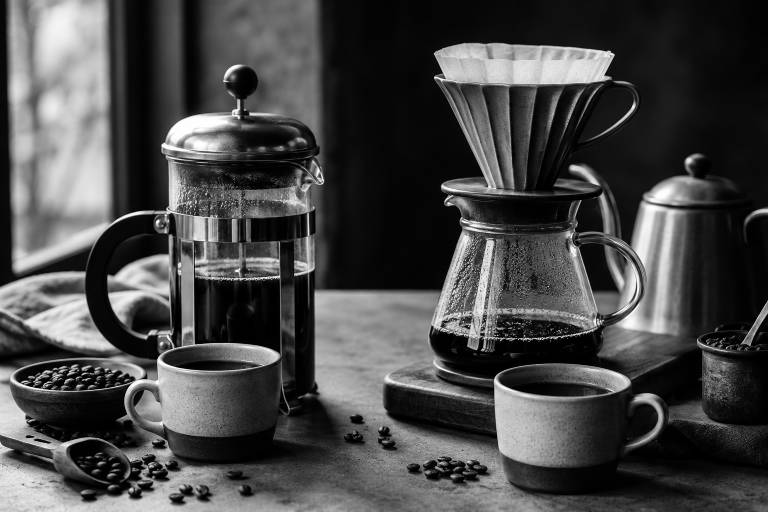
French press uses a method called immersion brewing, where coarse coffee grounds sit fully submerged in hot water for the entire steep.
After about four minutes, you push a plunger fitted with a fine metal mesh filter down through the water to separate the grounds from the liquid.
That metal screen lets natural coffee oils and micro-fine particles pass into your cup, which is why French press coffee feels heavier on your tongue and looks slightly cloudy.
Pour over works the opposite way.
You place medium-fine grounds in a paper filter inside a cone-shaped dripper, then pour hot water over them in slow, controlled circles.
Gravity pulls the water down through the coffee bed, and the paper filter traps oils, sediment, and fine particles before the liquid drips into your mug.
The result tastes lighter, cleaner, and more transparent than anything a metal screen can produce.
Beginner Note A French press needs no special pouring technique. Pour over relies on a steady, circular pour that takes a few sessions to get comfortable with.
What Does French Press vs Pour Over Coffee Taste Like
The flavor gap between these two methods is wide enough that most people notice it on the first sip.
French press coffee coats your mouth with a thick, almost syrupy texture.
Natural oils from the beans carry rich notes of chocolate, caramel, and roasted nuts, and the body lingers on your palate for several seconds after you swallow.
Pour over coffee feels more like clear broth than stew.
Bright acidity comes through first, followed by fruit, floral, or citrus notes that fade into a quick, crisp finish.
The paper filter removes the oils that create body, so the cup tastes more transparent and lets you pick apart individual flavor details.
| Feature | French Press | Pour Over |
|---|---|---|
| Body | Heavy, full | Light, silky |
| Flavor notes | Chocolate, nuts, caramel | Fruit, floral, citrus |
| Finish | Lingering, round | Clean, quick |
| Texture | Thick, oily | Smooth, tea-like |
| Sediment | Some grit at the bottom | None |
Dark and medium roasts tend to shine in a French press, where the immersion method amplifies their deep, sweet character.
Light roasts and single-origin beans often taste better as pour over, where the paper filter lets delicate origin flavors stand out without getting buried under oil and body.
Which Grind Size Works for Each Brewer
Grind size is the single most common reason a cup of French press or pour over coffee turns out wrong.
French press needs a coarse grind, roughly the texture of sea salt or breadcrumbs.
Grinding too fine sends tiny particles straight through the metal mesh filter into your cup, creating a muddy, over-extracted brew that tastes harsh and gritty.
Pour over needs a medium-fine grind, closer to the texture of table salt or granulated sugar.
Grinding too coarse for pour over lets water rush through the coffee bed without extracting enough flavor, leaving you with a sour, thin, watery cup.
A burr grinder set to the correct level is the single biggest upgrade you can make for either method.
- French press grind: Coarse, like sea salt. Steep time: 4 minutes.
- V60 pour over grind: Medium-fine, like table salt. Brew time: 2:30 to 3:30.
- Chemex grind: Medium-coarse, slightly finer than French press. Brew time: 3:30 to 4:30.
Common Mistake Never use the same grind for a French press and a pour over. A coarse French press grind in a pour over makes weak, sour coffee. A fine pour over grind in a French press creates sludge and bitterness.
Brew Ratios and Water Temperature for Each Method
The starting ratio for French press is 1:15, meaning 1 gram of coffee for every 15 grams of water, which translates to about 30 grams of coffee for a 450-milliliter pot.
Pour over works best starting at 1:16, which works out to about 18 grams of coffee for a 288-gram cup.
The slightly weaker ratio compensates for the fact that percolation brewing extracts flavor more efficiently than immersion brewing.
Water temperature for a French press sits between 195 and 205 degrees Fahrenheit (90 to 96 degrees Celsius).
Pour over works in the same range, though if you do not own a thermometer, boil the water and let it rest for 30 seconds before pouring.
| Variable | French Press | Pour Over |
|---|---|---|
| Starting ratio | 1:15 | 1:16 |
| Water temp | 195 to 205°F | 200 to 205°F |
| Grind | Coarse | Medium-fine |
| Contact time | 4 minutes steep | 2:30 to 3:30 active pour |
How Long Each Method Takes From Start to Finish
French press total time from boiling water to pouring your cup runs about 8 to 10 minutes.
That includes roughly 2 minutes to heat the water, 30 seconds to grind and load the press, a 4-minute steep, and a minute for the grounds to settle after plunging.
The process is almost entirely hands-off once you pour the water in.
Pour over total time is similar, around 6 to 8 minutes, but more of that time is active.
You spend about 3 minutes slowly pouring water in controlled circles, adjusting your flow rate, and watching the drawdown.
The bloom step alone, where you saturate the grounds with a small splash of water and wait 30 seconds for CO2 to escape, requires your full attention.
French press rewards patience, and pour over rewards presence.
If your mornings are rushed, the hands-off steep of a French press fits better than standing over a dripper with a gooseneck kettle.
Which Method Costs Less to Start
French press has the lower entry price.
A reliable glass French press from a brand like Bodum costs $20 to $40, and you can use any kettle you already own.
There are no ongoing filter costs, no specialized accessories required, and the press itself can last for years with basic care.
A pour over setup costs more upfront.
The dripper itself is cheap, often $8 to $25 for a plastic or ceramic Hario V60.
Paper filters add $5 to $10 every few months, and a gooseneck kettle, which most pour over guides strongly recommend, adds $30 to $60 to the initial investment.
A scale with a built-in timer helps with consistency for either method and runs about $15 to $25.
Estimated startup costs:
- French press kit (press + any kettle): $20 to $40
- Pour over kit (dripper + gooseneck kettle + filters): $55 to $95
- Shared gear (burr grinder + scale): $50 to $100
Long-term costs are nearly identical, since the beans are the same price no matter how you brew them, and a 12-ounce bag of quality coffee makes about 20 cups at around $0.50 per cup regardless of method.
Compared to a $5 daily coffee shop habit, either home method pays for itself within the first two weeks.
The Best Roasts and Beans for Each Brewer
French press amplifies body, sweetness, and oil-forward flavors.
Medium to dark roasts, chocolaty Brazilian naturals, earthy Sumatrans, and nutty blends all taste rich and satisfying through the metal mesh filter.
The immersion method extracts enough sweetness from these roasts to balance out any bitterness, and the oils give the cup a velvety weight that darker beans are built for.
Pour over highlights origin character, acidity, and delicate aromatics.
Light to medium roasts, fruity Ethiopian washed coffees, bright Kenyan SLs, and floral Colombians come alive through paper filtration.
The clean cup lets you taste specific processing and terroir details that a heavier method would cover up.
Quick Tip You can brew any bean in either method. The results just change. A fruity Ethiopian pour over will taste jammy and oil-forward in a French press. A dark Sumatran French press will taste thinner and sharper as a pour over. Match the roast to the method for the best experience.
Cleanup and Daily Convenience
Pour over wins the cleanup category by a wide margin.
Lift the paper filter out, toss it in the compost or trash, and rinse the dripper under warm water.
The entire process takes about 30 seconds.
A Chemex is just as easy: lift the thick paper filter, discard, and wipe the glass carafe with a cloth.
French press cleanup takes more effort.
You need to scoop or rinse out the wet grounds stuck at the bottom of the glass beaker, then disassemble the plunger screen to scrub off oily residue.
Coffee oils oxidize and turn rancid if left on the metal filter, so a weekly deep clean with hot water and a drop of dish soap keeps the next brew tasting fresh.
Skipping that step turns your next brew into something that smells faintly like a wet dishrag.
Do this, and your press will never add a stale, musty note to your morning cup.
One shortcut: fill the press with warm water right after pouring your coffee, swirl, and dump the grounds through a fine mesh strainer over the sink.
- Pour over cleanup: 30 seconds. Toss filter, rinse dripper.
- French press cleanup: 2 to 3 minutes. Scoop grounds, scrub plunger, rinse beaker.
- French press deep clean: Weekly soak of disassembled filter parts.
Does French Press or Pour Over Have More Caffeine
The caffeine difference between these two methods is smaller than most people expect.
French press uses a longer steep time and a slightly stronger ratio (1:15 vs 1:16), which can extract marginally more caffeine per cup.
Pour over uses hotter water flowing continuously through the grounds, which is a more efficient extraction process.
In practice, a standard 12-ounce serving from either method contains roughly 120 to 160 milligrams of caffeine when brewed with arabica beans.
The bean variety matters far more than the brewer.
Robusta beans contain nearly twice the caffeine of arabica, so switching beans makes a bigger difference than switching methods.
A strong 1:12 ratio in either brewer delivers more caffeine per sip than a mild 1:17 ratio.
Serving size and coffee-to-water ratio are the real caffeine levers, not whether you pressed or poured.
If you need a true jolt, add more coffee to your recipe instead of switching methods.
Health Differences Between French Press and Pour Over
The biggest health distinction comes down to one compound: cafestol.
Cafestol is a natural oil found in coffee beans that can raise LDL cholesterol when consumed regularly in high amounts.
Paper filters catch most of the cafestol before it reaches your cup, which is why filtered brewing methods like pour over, drip, and Chemex are considered safer for people who watch their cholesterol levels.
French press coffee passes through a metal mesh filter that lets cafestol flow freely into every cup.
Research published in the American Journal of Epidemiology found that drinking five cups of unfiltered coffee daily could raise LDL cholesterol by 6 to 8 percent over several weeks.
A companion diterpene called kahweol follows the same pattern, and paper filtration catches it just as effectively.
For one or two cups a day, the effect is minimal for most healthy adults.
Beyond cholesterol, coffee from either method delivers the same antioxidants and the same mild boost to alertness.
If you love French press but want to reduce cafestol, place a paper filter over the top of your mug and pour the coffee through it, or line the inside of the plunger with a round paper filter before brewing.
That simple paper layer removes more than 90 percent of the cafestol without killing the rich body you chose French press for in the first place.
Quick Tip Pour over is the safer daily choice for anyone managing high cholesterol. French press in moderation, one to two cups a day, is still a reasonable option for most people.
How to Decide Which Brewer Fits Your Morning
The right answer depends on four things: what you want your coffee to taste like, how much time you want to spend brewing, how much gear you want to buy, and how many cups you need at once.
Pick French press if you:
- Want rich, bold, full-bodied coffee with a thick mouthfeel
- Prefer a hands-off brewing process
- Drink medium to dark roasts
- Need to brew 3 to 4 cups at once
- Want the cheapest possible startup cost
Pick pour over if you:
- Want clean, bright, origin-forward flavors
- Enjoy a hands-on, meditative brewing ritual
- Drink light to medium roasts or single-origin beans
- Brew one to two cups at a time
- Want the easiest cleanup
Many coffee drinkers end up keeping one of each.
A French press handles lazy weekend mornings when you want something warm, heavy, and comforting with no fuss.
A pour over fits weekday mornings when you want a quick, clean cup and can appreciate the ritual of a slow, circular pour.
If you travel often, a small plastic pour over cone weighs almost nothing and fits in a backpack.
If you host brunch, a 34-ounce French press serves four people from a single batch.
The brewer does not make the coffee good.
Fresh beans ground right before brewing, accurate ratios, and clean water matter more than which device sits on your counter.
Start with whichever method matches your mornings, learn to brew it well, and upgrade your beans before you upgrade your gear.
A $15 bag of freshly roasted coffee in a $25 brewer will always taste better than stale supermarket grounds in a $200 setup.
Once you know how one method works, the other takes about 10 minutes to learn.
Try them side by side with the same beans, and your tongue will tell you which cup belongs in your morning.
The french press vs pour over debate does not have a single winner, and that is exactly the point.