That bag of specialty beans you brought home last weekend is already losing flavor right now, minute by minute, as invisible chemical reactions chip away at everything that made it smell so good in the first place.
Most people toss their coffee into a cabinet and forget about it, never realizing that storage is one of the single biggest factors separating a bright, aromatic morning cup from a flat, papery disappointment.
Learning how to store coffee beans correctly takes less than five minutes of effort, and the payoff shows up in every single brew.
Quick Answer
Store coffee beans in an opaque, airtight container at room temperature, away from heat, light, and moisture.
Whole beans stay at peak flavor for about 2 to 4 weeks after roasting, so buy in smaller batches and grind right before brewing.
Read on for container comparisons, freezing methods, and the storage myths that quietly ruin good coffee.
Why Coffee Beans Go Stale After Roasting
Coffee roasting triggers hundreds of chemical reactions inside each bean, creating the aromatic oils and sugars that give your cup its character.
Those same reactions produce large amounts of carbon dioxide that remain trapped in the bean’s porous structure.
Over the first 24 hours after roasting, beans release roughly 40% of that trapped CO2 in a process called degassing.
Degassing continues at a slower pace for days and weeks after roasting, and the escaping gas carries volatile aroma compounds with it.
Once enough CO2 has left the bean, oxygen moves in and begins breaking down the oils through coffee oxidation.
That oxidation is what turns a once-lively bag of beans into something that smells like cardboard and brews into a dull, lifeless cup.
Darker roasts degas faster and stale sooner, often within 5 to 7 days of peak flavor, since longer roast times make the bean structure more porous.
Lighter roasts hold onto their CO2 longer and can taste their best between 7 and 14 days after roasting.
Quick Tip Check the roast date on your bag, not the “best by” date. The roast date tells you exactly how fresh those beans really are.
The Four Enemies of Fresh Coffee Beans
When you store coffee beans at home, every decision comes down to blocking four specific threats.
Oxygen is the biggest one, and it works fast, breaking down the oils and aromatics that create layered flavor in your cup.
Moisture accelerates staling and can introduce musty, mildewed flavors that no brewing technique can fix.
Heat speeds up every chemical reaction involved in degradation, which means a bag sitting near your stovetop ages faster than one tucked inside a pantry shelf.
Light, particularly UV light, breaks apart the delicate compounds that give coffee its sweetness and fruit-forward notes.
A single week of exposure to all four of these enemies can do more damage than a month of proper storage.
| Threat | What It Does | How Fast It Works |
|---|---|---|
| Oxygen | Breaks down oils and aromatics | Noticeable within days |
| Moisture | Introduces musty, flat flavors | Noticeable within days |
| Heat | Accelerates all chemical breakdown | Gradual, cumulative |
| Light (UV) | Destroys sweetness and fruit notes | Gradual, cumulative |
Best Containers to Store Coffee Beans
The container you choose matters more than most people expect.
A good coffee canister creates a tight seal that keeps oxygen and moisture from sneaking in every time you scoop out your morning dose.
The original bag from your roaster, if it has a one-way valve and a resealable zip closure, works surprisingly well for the first week or two.
That one-way valve lets CO2 escape from freshly roasted beans without letting oxygen back inside, which is exactly what you want during the degassing window.
For longer storage, a dedicated airtight container with a silicone gasket lid gives you a more reliable seal than a folded-over bag clip.
Vacuum-style canisters like the Airscape or Fellow Atmos go a step further by physically pushing air out of the container before sealing, which slows coffee oxidation even more.
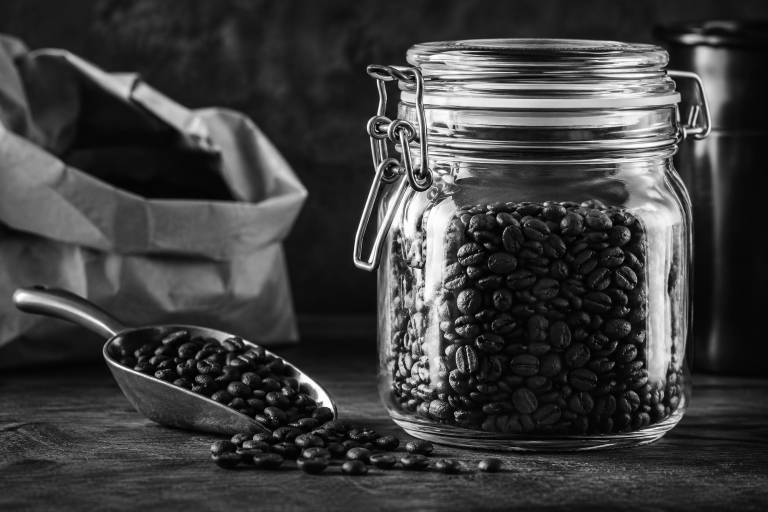
Stainless steel and ceramic canisters block 100% of light, making them a better choice than clear glass jars sitting out on a countertop.
If you prefer seeing your beans, a dark-tinted glass jar stored inside a closed cabinet still works.
Do
Do look for opaque materials and a silicone gasket seal
Do match the canister size to your weekly bean volume so less empty airspace remains
Don’t
Don’t store beans in a clear jar on your kitchen counter where sunlight hits
Don’t reuse old containers without washing them first, since rancid oils from previous batches can taint fresh beans
Where to Keep Your Coffee Beans in the Kitchen
The best storage spot is a cool, dry cabinet or pantry shelf that stays away from heat sources.
Avoid the shelf above your oven, the counter next to your toaster, and any spot that catches direct afternoon sunlight through a window.
A lower cabinet on the opposite side of the kitchen from your stove and dishwasher is an ideal location.
Temperature stability matters just as much as the average temperature itself.
A spot that swings from cool in the morning to warm in the afternoon creates condensation cycles inside your container, and that moisture speeds up staling.
Aim for a location that stays between 60 and 70 degrees Fahrenheit throughout the day.
The refrigerator might seem logical, but it is one of the worst places to store coffee beans.
Fridges are full of moisture and food odors, and coffee is hygroscopic, meaning it absorbs smells and dampness from everything around it.
Opening the fridge multiple times a day creates temperature shifts that cause condensation on the bean surfaces.
How Long Do Coffee Beans Stay Fresh?
Coffee freshness is a sliding scale, not a cliff, and how you store coffee beans determines where you fall on it.
Whole beans hit their flavor peak around 4 to 14 days after roasting, depending on the roast level and brewing method.
After 2 to 4 weeks, most beans have lost enough aromatic compounds that the difference becomes obvious in the cup, even to casual drinkers.
The table below shows approximate freshness windows for different forms of coffee stored in an airtight container at room temperature.
| Coffee Form | Peak Flavor Window | Still Drinkable |
|---|---|---|
| Whole beans (sealed) | 4 to 14 days post-roast | Up to 4 weeks |
| Whole beans (opened) | 1 to 3 weeks | Up to 4 weeks |
| Ground coffee (opened) | 1 to 5 days | Up to 2 weeks |
| Vacuum-sealed whole beans | 2 to 4 weeks | Up to 2 months |
That “best by” date printed on grocery store bags often sits 6 to 12 months past the actual roast date.
By the time you open a bag with no roast date printed on it, the beans may already taste flat, with that familiar papery, cardboard-like note that signals stale coffee.
Beginner Note Buy coffee in quantities you can finish within 2 weeks. A 12-ounce bag is a good starting point if you brew one to two cups per day.
Whole Bean vs Ground: Which Stays Fresher Longer?
Whole bean coffee wins this comparison by a wide margin.
A whole bean has a compact structure that limits how much surface area oxygen can attack at any given time.
The moment you grind those beans, you shatter that protective structure into thousands of tiny particles, each one exposing fresh oils and aromatics to the air.
Ground coffee can lose up to 60% of its aroma within the first 15 minutes after grinding, which is why coffee shops grind to order instead of pre-grinding bins of beans every morning.
After two weeks in an airtight container, whole beans retain about 85% of their aroma compounds, compared to roughly 25% for ground coffee stored the same way.
The flavor difference is not subtle.
Freshly ground whole bean coffee tastes cleaner, sweeter, and more complex than pre-ground coffee from the same bag, and every coffee professional will tell you the same thing.
If you do not own a grinder yet, a decent burr grinder costs between $30 and $60, and it will change your morning cup more than any other single upgrade.
Should You Freeze Coffee Beans?
Freezing coffee beans is a surprisingly effective method for long-term storage, and many specialty roasters now recommend it.
An SCA board member has described immediate freezing after roasting as the single most effective method for delaying spoilage, with beans holding up well for months and even up to a year in a dedicated freezer.
The science behind freezing coffee is straightforward: cold temperatures slow down chemical reactions, including the oxidation that makes beans go stale.
Research suggests that one day at room temperature equals roughly 200 days in the freezer when measuring flavor degradation.
Freezing is the right choice when you have more beans than you can use within 2 to 3 weeks, when you found a limited release coffee you want to preserve, or when you bought in bulk to save money.
Freezing is the wrong choice for beans you plan to brew this week, since the extra handling introduces unnecessary risk of moisture exposure.
- Freeze only freshly roasted beans, ideally within the first week after the roast date
- Never freeze ground coffee, since the expanded surface area absorbs freezer odors fast
- Avoid freezing beans that are already more than 3 weeks past their roast date
How to Freeze Coffee Beans the Right Way
The biggest mistake people make when they store coffee beans in the freezer is tossing an open bag in and pulling it out repeatedly.
Every time you open a frozen container, warm air rushes in, condensation forms on the cold bean surfaces, and that moisture damages the flavor.
Portion your beans into single-use amounts before freezing.
Divide your supply into bags that each hold about one week’s worth of coffee, roughly 2 to 4 ounces per bag.
Vacuum-sealed bags are the gold standard here, since they remove nearly all the oxygen from the package.
If you do not have a vacuum sealer, press as much air out of a heavy-duty zip-lock bag as possible, then wrap it in a second bag for extra protection.
Label each bag with the coffee name, the roast date, and the freeze date so you can track freshness later.
When you are ready to brew, pull one bag from the freezer and let it thaw completely at room temperature, still sealed, before opening it.
This thawing step prevents condensation from forming on the cold beans when they meet warm kitchen air.
Once a bag is thawed, do not refreeze it.
Common Mistake Grinding beans straight from the freezer can produce a more uniform grind particle size, but only if your grinder handles frozen beans well. Most affordable home grinders struggle with frozen beans, so thawing first is the safer bet.
Signs Your Coffee Beans Have Gone Stale
Your senses can detect stale coffee before you even start brewing.
Fresh beans release a strong, fragrant wave of aroma the moment you open the bag, with notes that might smell like chocolate, fruit, nuts, or caramel depending on the origin and roast level.
Stale beans barely smell like anything at all, or they give off a flat, papery scent that feels more like opening a dusty cabinet than opening a bag of coffee.
Rub a few beans between your fingers.
Fresh beans feel slightly oily and leave a faint residue on your skin, which signals that the natural coffee oils are still intact.
Stale beans feel dry, grainy, and papery, with no oil residue, meaning those flavor-carrying oils have already evaporated.
The bloom test is another reliable indicator: when you pour hot water over fresh grounds in a pour-over or French press, the coffee should bubble and puff up as trapped CO2 escapes.
No bloom at all means the beans have fully degassed and are well past their peak coffee freshness window.
Stale coffee in the cup tastes flat, hollow, and one-dimensional, often with an unpleasant bitter or sour edge that was not present when the beans were fresh.
Common Coffee Storage Myths That Waste Good Beans
Several popular storage tips actually do more harm than good.
Myth: The fridge keeps beans fresh. Your refrigerator is cold, yes, but it is a humid, odor-filled environment.
Coffee absorbs surrounding smells and moisture within hours of being placed in a fridge without a perfect airtight seal, and most people do not have one that qualifies.
Myth: Vacuum sealing makes beans last forever. Vacuum sealing removes most of the oxygen, which slows staling, but it does not stop it entirely.
Internal chemical reactions still continue inside the bean, just at a slower pace.
Plan on using vacuum-sealed beans within 1 to 2 months for peak flavor.
Myth: Grinding before storing saves time without hurting flavor. Pre-grinding is the fastest way to ruin good beans.
Ground coffee goes stale 4 to 5 times faster than whole bean coffee stored the same way.
The 30 seconds of grinding you skip in the morning costs you hours of aroma and depth.
Myth: The bag from the grocery store is fine for long-term storage. Grocery store bags without a roast date are often already weeks or months past roasting by the time they reach the shelf.
Transferring those beans to an airtight container helps, but the damage from oxygen exposure during that shelf time cannot be reversed.
How to Buy Coffee for Better Freshness at Home
The way you store coffee beans matters, but storage starts before you even open the bag.
Buying from a local roaster or an online roaster that prints a roast date on every bag is the single most effective freshness habit you can adopt.
A bag with a clear roast date lets you count the days and plan your purchases around peak flavor windows.
Buy in quantities that match your consumption pace: a 12-ounce bag for one to two cups per day, a full pound if you brew a pot every morning.
Whole bean coffee always outlasts ground coffee, so choose whole beans whenever you have access to a grinder.
Look for bags with a one-way valve, which is a small plastic disc embedded in the packaging that lets CO2 escape without letting air inside.
Quick Tip Set a phone reminder for 10 days after your roast date. That is your “use it or freeze it” deadline for most medium-roast coffees.
If you find a coffee you love, buy two bags: one for this week and one to freeze immediately in portioned, vacuum-sealed bags for next month.
That simple habit gives you fresh coffee on demand without rushing through a bag or watching good beans go stale on your shelf.
Your beans deserve the same care you put into choosing your brew method, your water temperature, and your grind size.
Get the storage right, and every other step in your coffee routine pays off a little more.