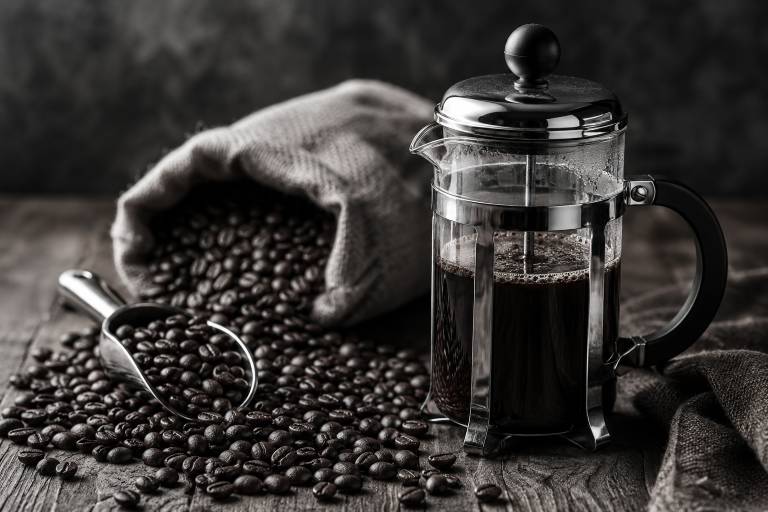
A thick, velvety pour of French press coffee that smells like dark chocolate and toasted walnuts can change an entire morning.
That kind of cup starts with the right dark roast coffee beans, and the French press is built to show them off.
Full immersion brewing pulls oils, sugars, and body from the grounds in a way that paper-filtered methods cannot match.
Dark roast beans respond to this process with a heavy mouthfeel, low acidity, and rich caramel sweetness that coats the tongue.
The wrong beans, on the other hand, turn that same immersion time into a bitter, ashy mess.
This guide covers the best dark roast coffee beans for French press brewing, the technique adjustments that make dark roasts sing in a press pot, and the mistakes that ruin even premium beans.
Quick Answer
The best dark roast coffee beans for French press are fresh, whole bean, 100% Arabica roasts with flavor notes of chocolate, caramel, or toasted nuts and low acidity. Peet’s Major Dickason’s Blend and Kicking Horse Kick Ass are two of the most reliable choices for bold, smooth French press results.
Use water between 185°F and 195°F for dark roasts in a French press, and keep your steep time closer to 3.5 to 4 minutes to avoid over-extraction.
Read on for five specific bean recommendations, a brewing method tuned for dark roast, and the common errors that make French press coffee taste burnt.
Why Dark Roast Beans Taste Better in a French Press
Dark roast beans and the French press share a natural partnership that goes back to the chemistry of immersion brewing.
The metal mesh filter on a French press lets oils pass straight into the cup, and dark roast beans carry more surface oils than lighter roasts.
Those oils are where much of the body and sweetness live.
During roasting, dark roast beans pass through what roasters call the “second crack,” a point near 435°F (224°C) where the bean’s cellular structure fractures and oils migrate outward.
That process caramelizes sugars deeply, reduces acidity, and produces the glossy, dark brown surface that dark roast drinkers recognize on sight.
In a French press, this all translates to a cup that feels thick on the palate, tastes of bittersweet chocolate and roasted nuts, and finishes with a smoky sweetness instead of a sharp bite.
Beginner Note A “French Roast” label on a bag refers to a very dark roast level, not a bean type made for the French press. French Roast beans work in a press pot, but they are just one shade on the dark roast spectrum.
Lighter roasts can taste thin or sour when brewed in a press pot, since their higher acidity and denser structure need hotter water and more precise timing to extract well.
Dark roasts are more forgiving: steep a dark roast 30 seconds too long, and the flavor shifts only slightly, whereas a light roast punishes the same mistake with a harsh tannic edge.
That forgiveness makes dark roast the easiest entry point for anyone learning to brew with a French press.
What to Look for When Choosing Dark Roast Beans
The label on a coffee bag can tell you a lot, if you know which details matter.
Start with the roast date, not the “best by” date.
Dark roast beans go stale faster than light roasts, since their porous structure lets aromatic compounds escape more quickly.
One Seattle roaster has noted that a very dark French Roast can start tasting flat in as few as four days after roasting.
For most dark roasts, the sweet spot sits between 7 and 21 days post-roast.
Buy whole bean, every time.
Pre-ground coffee loses aroma within minutes of grinding, and the coarse grind that a French press requires is rarely what you get from a pre-ground bag on a grocery shelf.
A basic burr grinder (around $25 for a hand model) pays for itself in flavor within the first week.
| Feature | What to Look For | What to Avoid |
|---|---|---|
| Roast Date | Within 7 to 21 days | “Best by” date only, no roast date |
| Bean Type | 100% Arabica or specialty-grade blend | Unlabeled blends with Robusta filler |
| Grind | Whole bean | Pre-ground (wrong grind size for press) |
| Origin | Latin America, Indonesia, or multi-origin blend | No origin listed |
| Flavor Notes | Chocolate, caramel, nuts, toffee | “Bold” with no specific tasting notes |
| Certifications | Organic, Fair Trade, or direct trade (optional) | None required, but indicates sourcing care |
Bag size matters for freshness, too.
A 2-pound bag is a better value per ounce, but if you brew only one cup a day, that coffee will be 30+ days old before you finish the bag.
For single-cup brewers, 10 to 12 ounce bags keep the beans fresher from first scoop to last.
5 Dark Roast Coffee Beans Worth Brewing in a French Press
Not every dark roast earns a spot in a French press.
The beans below have earned consistent praise for delivering bold flavor without crossing into bitter or ashy territory, and each one is available as whole bean for home grinding.
1. Peet’s Major Dickason’s Blend

- Contains one (1) 18 Ounce Bag of Peet’s Major Dickason’s Blend Ground 100% Arabica Coffee
- Flavor and Roast: Dark Roast. Flavorful, robust, full-bodied. Developed by Mr. Peet and his most…

Peet’s flagship dark roast has been a best-seller since Alfred Peet and a loyal customer named Dickason developed it in 1969.
The blend uses Latin American and Indo-Pacific beans roasted to a deep, full-bodied profile with layers of chocolate, earth, and warm spice.
In a French press, it produces a heavy, almost chewy body with a lingering cocoa finish that works beautifully with a splash of cream.
Peet’s ships online orders roasted the same day, and you can choose whole bean or a coarse grind option built for press pot brewing.
2. Kicking Horse Kick Ass

- TASTING NOTES: Chocolate malt, molasses, licorice and an earthy lingering finish.
- DARK ROAST: Velvety, earthy, spirited. This smooth riding dark horse conjures up power from the…
This certified organic, Fair Trade dark roast blends Arabica beans from Indonesia and South America into a smoky, sweet cup with tasting notes of chocolate malt, molasses, and licorice.
The aroma hits you the moment you open the bag: sweet vanilla layered over dark chocolate.
In a French press, the body is dense and earthy, with a long finish that warms the back of the throat.
Kicking Horse roasts in the Canadian Rocky Mountains and recommends this blend for French press and cold brew.
3. Mayorga Café Cubano Roast

- MAYORGA COFFEE CUBANO ROAST – Our Roastmaster craft roasts our coffees from Peru, Honduras and/or…
- 100% ARABICA WHOLE BEAN COFFEE – Start your day by enjoying the freshness of our organic coffee…
Mayorga is a Latino-owned company that slow-roasts organic beans from Peru, Honduras, and Nicaragua to replicate a traditional Cuban-style coffee profile.
The result smells like caramel and light vanilla, with a syrupy smokiness that lingers in the cup.
Acidity is very low, making this one of the smoothest dark roasts you can put in a French press.
The company sources from regenerative partner farms and holds USDA Organic, Non-GMO, and Kosher certifications.
4. San Francisco Bay French Roast

- One of our most popular coffees, French Roast is sourced from Central and South America arabica…
- For finest taste, store in a cool, dark place and grind beans just berfore brewing
A budget-friendly 2-pound bag of 100% Arabica beans from Central and South America, this French Roast delivers dark chocolate, brown spice, and a long smoky finish at roughly half the per-ounce cost of many specialty brands.
San Francisco Bay is a family-owned company that uses sustainably sourced, shade-grown beans.
The flavor leans heavily smoky, which makes it a strong pick for people who enjoy their coffee black and intense.
It pairs well with milk or cream, too, since the bold roast character cuts through dairy without losing definition.
5. Lifeboost Embolden Dark Roast

- DELICIOUS, ETHICALLY SOURCED COFFEE: You’ve tried the rest, now buy the best; Lifeboost Non-GMO…
- GROWN IN THE MOUNTAINS OF CENTRAL AMERICA: Lifeboost Single Origin Acid Free Coffee is shade grown…
Lifeboost’s single-origin dark roast comes from shade-grown farms in Nicaragua and delivers a naturally sweet cup with notes of dark chocolate, nuts, and a jammy fruit undertone.
The roast level sits on the darker side without reaching French or Italian roast territory, so there is no smoky or charred edge.
Acidity is very low, and the body feels rich and earthy rather than oily.
Lifeboost sells whole bean or pre-ground, but the pre-ground option is a medium grind designed for drip machines, so grind your own for French press.
Quick Tip If you order beans online, check whether the roaster ships on the roast date. Peet’s and several small-batch roasters ship same-day, which means your beans arrive at peak freshness rather than sitting in a warehouse.
How These Five Dark Roasts Compare Side by Side
Choosing between these beans comes down to flavor preference, budget, and how fast you drink through a bag.
| Bean | Flavor Profile | Best For | Price Range | Bag Size |
|---|---|---|---|---|
| Peet’s Major Dickason’s | Chocolate, earth, spice | Everyday bold brewing | $10 to $20 | 10.5 oz to 32 oz |
| Kicking Horse Kick Ass | Chocolate malt, molasses, licorice | Organic, smoky intensity | $17 to $27 | 10 oz to 2.2 lb |
| Mayorga Café Cubano | Caramel, vanilla, syrupy smoke | Smooth, low-acid cup | $14 to $32 | 12 oz to 5 lb |
| SF Bay French Roast | Dark chocolate, brown spice, smoke | Budget-friendly volume | ~$20 | 2 lb |
| Lifeboost Embolden | Dark chocolate, nuts, fruit | Low-acid, no smoky edge | $28 to $35 | 12 oz |
For the best value per cup, San Francisco Bay’s 2-pound bag is hard to beat.
For the smoothest, most stomach-friendly cup, Mayorga and Lifeboost stand out with their very low acidity.
Peet’s Major Dickason’s Blend sits in the middle: affordable, widely available, and reliably bold.
How to Brew Dark Roast Beans in a French Press
Dark roast beans need slightly different handling than medium or light roasts in a French press.
The biggest adjustment is water temperature.
Standard French press guides call for water at 200°F to 205°F, but that range can push dark roast beans into over-extraction, producing a bitter, ashy taste.
Drop your water temperature to 185°F to 195°F for dark roasts.
At 195°F, the coffee extracts more slowly, which gives you sweetness and body without pulling out harsh compounds.
A variable-temperature electric kettle makes this easy to control; if you do not have one, let a full boil sit for about 60 to 90 seconds before pouring.
Here is the step-by-step method:
- Grind your beans to a coarse consistency, similar to coarse sea salt.
- Use a ratio of 1:15 (1 gram of coffee to 15 grams of water). For a standard 34-ounce French press, that is roughly 60 grams of coffee and 900 grams of water.
- Pour a small amount of hot water over the grounds and let them bloom for 30 seconds. You will see the coffee puff up and release trapped carbon dioxide.
- Add the remaining water, place the lid on without pressing the plunger, and set a timer for 3 minutes and 30 seconds to 4 minutes.
- At the end of the steep, press the plunger down slowly and steadily. Forcing it creates turbulence that stirs up fine particles and increases bitterness.
- Pour the coffee into your mug or a carafe immediately. Coffee left sitting on the grounds in a French press continues to extract and turns bitter within minutes.
Common Mistake Pre-heating your French press with hot water before brewing is not just a nice touch. A room-temperature glass carafe will drop your water temperature by 10°F or more on contact, pushing your brew below the extraction threshold and leaving the coffee tasting weak and sour.
Mistakes That Make Dark Roast French Press Coffee Taste Burnt
A dark roast that smells amazing in the bag but tastes like charcoal in the cup is almost always a brewing error, not a bean problem.
Water temperature that is too high sits at the top of the list.
Boiling water (212°F) on a dark roast bean that has already been roasted past the second crack extracts bitter tannins and ashy compounds at a rapid pace.
The fix is simple: keep your water between 185°F and 195°F.
Do / Don’t
- Do grind coarse and even. A fine grind over-extracts in the 4-minute steep time and creates sludge at the bottom of your cup.
- Don’t leave brewed coffee sitting on the grounds. Pour everything out the moment you finish pressing.
- Do use filtered water. Tap water with heavy chlorine or mineral content can amplify bitterness.
- Don’t use stale beans. Dark roast beans that are more than 3 weeks past their roast date lose sweetness and develop flat, papery off-flavors.
- Do plunge slowly. A fast, hard plunge forces fine coffee particles through the mesh filter.
- Don’t skip the bloom. That 30-second bloom releases carbon dioxide that would otherwise create an uneven extraction.
Grind consistency deserves extra attention.
A blade grinder chops beans unevenly, producing a mix of fine dust and large chunks that extract at different rates.
The dust over-extracts (bitter), and the chunks under-extract (sour), giving you a muddy cup that tastes off in every direction.
A burr grinder, even an inexpensive hand-crank model, produces uniform particles that extract at the same rate and deliver a cleaner, sweeter cup.
Dark Roast vs. Medium Roast in a French Press
Many French press guides recommend medium roast as the default, and that advice is not wrong, just incomplete.
Medium roasts deliver a balanced cup with more origin character: fruit-forward notes, brighter acidity, and a lighter body.
Dark roasts trade that brightness for depth: think chocolate instead of citrus, caramel instead of berry, and a heavy body that fills the mouth.
| Attribute | Dark Roast | Medium Roast |
|---|---|---|
| Body | Full, heavy, syrupy | Medium, smooth |
| Acidity | Low to very low | Moderate |
| Dominant Flavors | Chocolate, smoke, caramel, nuts | Fruit, toffee, light cocoa |
| Forgiveness | High (tolerates timing errors) | Moderate (over-steep turns bitter) |
| Ideal Water Temp | 185°F to 195°F | 195°F to 205°F |
| Freshness Window | 7 to 21 days post-roast | 7 to 30 days post-roast |
| Cold Brew Suitability | Excellent | Good |
If you add milk, cream, or sweetener to your coffee, dark roast holds up better.
The bold roast character cuts through dairy and sugar without getting lost, which is why most café lattes use dark or espresso-level roasts as their base.
For drinking black, medium roast can be more layered and complex, but dark roast delivers the warm, comforting weight that many coffee drinkers associate with “a good cup.”
How to Keep Dark Roast Beans Fresh After Opening
Dark roast beans are more fragile than lighter roasts.
The porous structure created during extended roasting allows oxygen, moisture, and light to degrade flavor faster.
Store your beans in an airtight, opaque container at room temperature.
A ceramic canister with a silicone-sealed lid works well, and so does the original bag if it has a zip-seal and a one-way degassing valve.
- Keep beans away from direct sunlight, heat sources, and the stove top.
- Do not store beans in the refrigerator. The cold environment creates condensation every time you open the container, and that moisture accelerates staleness.
- Do not freeze beans. The only exception is a sealed, unopened bag you plan to store for longer than 3 weeks. Once frozen beans thaw, use them within a week.
- Grind only what you need for each brew session. Ground coffee goes stale 10 to 15 times faster than whole bean.
A 12-ounce bag of dark roast beans should ideally be used within 10 to 14 days of opening.
If you find yourself taking longer than that, buy smaller bags or split a large bag into two sealed portions and open the second one only when the first is empty.
French Press Cold Brew With Dark Roast Beans
Your French press doubles as a cold brew maker with zero extra equipment.
Dark roast beans are one of the strongest choices for cold brew, since the cold water extraction pulls sweetness and body from the grounds without extracting the bitter compounds that hot water can release.
The result is a smooth, naturally sweet concentrate with a chocolatey depth that tastes nothing like iced drip coffee.
Cold Brew Method:
- Grind 80 grams of dark roast beans to a coarse setting (slightly coarser than you would for hot French press).
- Add the grounds to your French press.
- Pour 480 grams (about 2 cups) of cold, filtered water over the grounds and stir gently.
- Place the lid on without pressing the plunger and refrigerate for 16 to 20 hours.
- Press the plunger slowly and pour the concentrate into a jar or bottle.
- Dilute with water, milk, or ice at a 1:1 ratio for drinking strength, or pour it straight over ice for a stronger cup.
This concentrate keeps in the refrigerator for up to 7 days.
Quick Tip If your cold brew tastes chalky or dry, shorten the steep time to 14 hours. If it tastes thin and watery, extend it to 22 hours or use a slightly finer grind.
One batch of 80 grams produces about 2 cups of concentrate, enough for 4 diluted servings.
At roughly $0.50 to $1.00 per serving depending on your beans, homemade cold brew costs a fraction of the $5 to $6 you would spend at a coffee shop.
Picking the Right Dark Roast for Your Taste
Not every dark roast drinker wants the same cup.
Some people love heavy smoke and char.
Others want a dark roast that still has sweetness, fruit undertones, or a clean finish.
Your preference points you toward different beans and origins.
- If you want smoky, intense flavor: Look for beans labeled “French Roast” or sourced from Indonesian origins (Sumatra, Java). San Francisco Bay French Roast and Kicking Horse Kick Ass lean in this direction.
- If you want smooth, sweet, low-acid flavor: Choose Latin American origins (Colombia, Peru, Honduras, Nicaragua) with slow-roast profiles. Mayorga Café Cubano and Lifeboost Embolden fit this category.
- If you want a balanced, all-purpose dark roast: Multi-origin blends like Peet’s Major Dickason’s combine beans from several regions to create a cup with depth, complexity, and no single overwhelming note.
The best way to find your preference is to try two or three of these beans over the course of a month, brewing each one in the same French press with the same ratio and water temperature.
That controlled comparison reveals what you actually prefer, stripped of variables.
Dark roast coffee beans and a French press together produce one of the richest, most satisfying cups you can make at home.
The combination rewards simple technique: fresh whole beans, a coarse burr grind, water at 185°F to 195°F, and 4 minutes of patience.
Start with a widely available option like Peet’s Major Dickason’s Blend or Kicking Horse Kick Ass, dial in your grind and timing, and then branch out to single-origin dark roasts or organic options like Mayorga Café Cubano.
The cup waiting on the other side of that process, heavy with cocoa and caramel, warm and smooth, is worth every small adjustment.