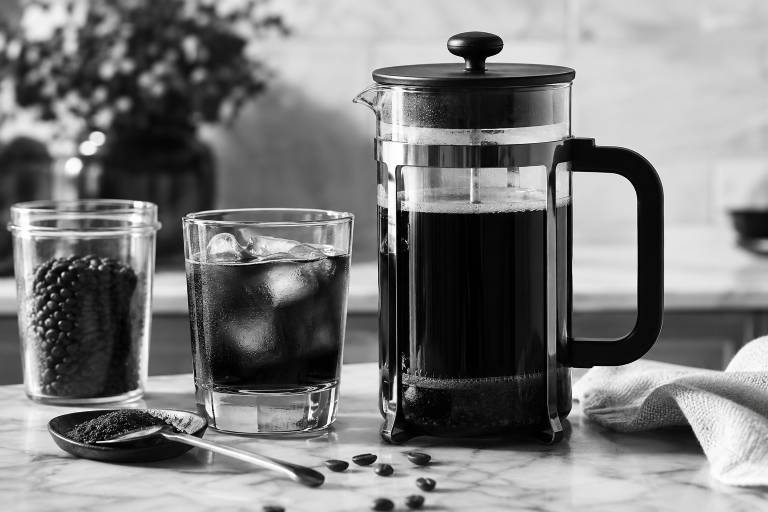
A french press cold brew recipe turns the brewer you already own into an overnight cold coffee machine.
Cold water pulls sweetness and chocolate notes from ground coffee without the bitterness that hot brewing creates.
The mesh plunger handles all the filtering, so you skip paper filters, cheesecloth, and messy straining.
Five minutes of setup before bed gives you a full batch of smooth concentrate ready for the morning.
This guide walks through the exact ratio, grind size, steep time, and flavor variations you need for a perfect batch every time.
Quick Answer
Combine 70 grams of coarsely ground coffee with 560 grams of cold filtered water in a french press (a 1:8 ratio for ready-to-drink cold brew). Steep for 14 to 18 hours in the refrigerator, then press the plunger slowly and pour over ice.
If you prefer a stronger concentrate, use a 1:5 ratio and dilute 1:1 with water or milk when serving.
Keep reading for grind size details, steeping comparisons, flavor add-ins, and storage tips that keep your cold brew fresh all week.
Why a French Press Works So Well for Cold Brew
The french press was built for immersion brewing, the exact method cold brew relies on.
Coffee grounds sit fully submerged in water for hours, and the metal mesh filter separates them cleanly when you press down.
That means no extra equipment, no paper filters that clog under cold water’s slow drip, and no second straining step.
The glass carafe lets you watch the water darken from pale gold to deep amber as extraction happens overnight.
Quick Tip Place the lid on with the plunger pulled all the way up during steeping. Pressing down early traps grounds against the filter and can cause uneven extraction.
A standard 34-ounce (1-liter) french press produces about four cups of cold brew concentrate, which translates to eight to twelve servings once diluted.
Smaller 12-ounce presses work too, making a single day’s worth of cold brew for one person.
What You Need Before You Start Brewing
Gathering everything before you begin keeps the process under five minutes from start to fridge.
| Item | What to Look For | Approximate Cost |
|---|---|---|
| French press | 34 oz (1 L) glass or stainless steel | $15 to $35 |
| Coffee beans | Medium or dark roast, whole bean | $10 to $18 per 12 oz bag |
| Burr grinder | Any manual or electric burr grinder | $30 to $60 |
| Kitchen scale | Measures in grams | $10 to $15 |
| Filtered water | Tap water run through a basic pitcher filter | $20 for a filter pitcher |
| Airtight jar | Glass mason jar or pitcher with a lid, for storing concentrate | $5 to $10 |
Pre-ground coffee from the grocery store can work in a pinch, but it is often ground too fine for cold brew.
Whole beans ground fresh at home give you control over particle size and produce a cleaner, less gritty result.
A kitchen scale removes guesswork entirely and costs less than two bags of specialty coffee.
Step-by-Step French Press Cold Brew Recipe
This recipe produces a ready-to-drink cold brew at a 1:8 ratio, smooth enough to pour over ice without diluting.
Weigh 70 grams of whole coffee beans and grind them on the coarsest setting your grinder offers.
The grounds should look and feel like raw sugar or coarse sea salt, with visible individual particles and no powdery dust.
Pour the grounds into the bottom of your french press.
Add 560 grams (about 2.5 cups) of cold filtered water and stir gently for ten seconds to saturate every particle.
You will smell a faint earthy sweetness rising from the slurry, much softer than the sharp aroma of hot coffee.
Place the lid on the press with the plunger pulled up, and set the entire unit in the refrigerator.
Steep for 14 to 18 hours, then press the plunger down slowly and steadily.
Pour the cold brew into a glass jar or pitcher, and rinse the french press right away to prevent old grounds from staining the glass.
Serve over ice, or store the batch in the refrigerator for up to seven days.
Beginner Note If your french press is too tall to fit in the fridge with the lid on, cover the top with plastic wrap or aluminum foil instead. The lid is not required during steeping.
How to Choose the Right Coffee-to-Water Ratio
The ratio you pick determines whether you are making a concentrate or a finished drink.
A 1:5 ratio (70 grams of coffee to 350 grams of water) creates a thick, syrupy concentrate that needs diluting before you drink it.
A 1:8 ratio (70 grams of coffee to 560 grams of water) gives you a ready-to-drink cold brew that pours straight over ice.
Going higher than 1:10 often produces a thin, tea-like cup that lacks the round body cold brew is known for.
| Ratio | Style | Dilution Needed | Servings per 1 L Press |
|---|---|---|---|
| 1:5 | Concentrate | Dilute 1:1 with water or milk | 8 to 12 |
| 1:8 | Ready to drink | None | 4 to 5 |
| 1:10 | Light ready to drink | None, but may taste weak | 4 to 5 |
For a concentrate recipe that doubles as a base for lattes, mochas, and flavored drinks, the 1:5 ratio is more practical.
It takes up less fridge space and stretches further across the week.
If you want to grab a glass and drink it black over ice with no extra steps, stick with 1:8.
How Long to Steep French Press Cold Brew
Steep time controls how much flavor, sweetness, and caffeine the water pulls from the grounds.
Under 12 hours usually produces a sour, thin brew that tastes under-extracted.
The 14-to-18-hour window hits the sweet spot, where chocolate, caramel, and nutty notes come through without bitterness.
Pushing past 24 hours pulls harsh, woody, astringent compounds from the grounds and makes the cold brew taste over-extracted and unpleasant.
- 8 to 10 hours: Noticeably sour, weak body, pale color
- 12 to 14 hours: Mild flavor, slightly thin, good starting point
- 14 to 18 hours: Full extraction, smooth, balanced sweetness
- 20 to 24 hours: Stronger flavor, edges of bitterness, higher caffeine
- Beyond 24 hours: Bitter, harsh, vegetal, and undrinkable for most people
Set a phone alarm when you put the french press in the fridge so you do not accidentally steep for two full days.
A batch started at 8 p.m. will be ready between 10 a.m. and 2 p.m. the next day, fitting neatly into a morning routine.
How to Dilute Cold Brew Concentrate Before Drinking
Drinking undiluted cold brew concentrate is like eating unsweetened baking chocolate, technically possible but far too intense for most palates.
A standard dilution for cold brew concentrate is 1:1, meaning one part concentrate to one part water, milk, or your preferred liquid.
Pour four ounces of concentrate over a tall glass of ice, add four ounces of cold water, and stir.
The drink should taste smooth, full-bodied, and slightly sweet, with none of the sharpness you get from hot-brewed coffee poured over ice.
Common Mistake Adding milk or creamer directly to the full batch of concentrate in the fridge cuts its shelf life from seven days down to two or three. Dilute each serving individually.
Oat milk adds a creamy, grain-like sweetness that pairs well with medium roasts.
Coconut milk brings a subtle tropical note that plays off the chocolate tones in darker roasts.
Plain cold water is the purest way to taste the coffee itself.
Which Coffee Beans Make the Best French Press Cold Brew
Cold brewing mutes acidity and amplifies sweetness, so the roast level and origin you choose shape the final cup more than brewing technique alone.
Medium roasts deliver a balanced cup with notes of milk chocolate, brown sugar, and toasted nuts.
Dark roasts produce a bolder, smokier cold brew with lower acidity and heavier body, tasting like dark chocolate and molasses.
Light roasts can work, but they often come out thin and sour in cold brew, lacking the round sweetness that longer roast times develop.
Single-origin beans from Brazil, Colombia, or Guatemala tend to produce cold brew with clean sweetness and low acidity.
African beans (Ethiopia, Kenya) add fruity, berry-like brightness that can taste unexpected in a cold cup, exciting for some drinkers and off-putting for others.
For your first cold brew batch, a medium-dark blend labeled for cold brew or french press brewing is the safest starting point.
Grind Size and Why It Matters for Cold Brew
Grind size is the single biggest factor separating a clean, sweet cold brew from a muddy, bitter mess.
Cold brew needs an extra-coarse grind, visibly coarser than what you would use for hot french press coffee.
The particles should resemble raw sugar or cracked peppercorns, each one large enough to pick up between your fingers.
Fine grounds over-extract during a long steep, pulling out harsh tannins and creating a chalky, astringent mouthfeel that lingers on your tongue.
They slip through the french press mesh filter and leave gritty sediment at the bottom of your glass.
On a Baratza Encore grinder, settings 30 to 40 land in the right zone for cold brew.
On a Comandante hand grinder, 30 to 35 clicks gets you there.
If you do not own a grinder, ask your local roaster to grind the beans on the coarsest setting available, and tell them it is for cold brew.
- [x] Grounds feel chunky, not sandy
- [x] No visible powder or dust in the batch
- [x] Individual particles are easy to see
- [x] Plunger presses down smoothly without resistance
- [x] Finished brew looks clear, not murky
Room Temperature Steeping Compared to Refrigerator Steeping
Where you leave the french press during steeping changes extraction speed, flavor balance, and food safety.
Room temperature water (around 68 to 72 degrees Fahrenheit) extracts faster than refrigerator water (around 38 to 40 degrees Fahrenheit).
A room temperature steep finishes in 12 to 16 hours, pulling more of the coffee’s soluble compounds in less time.
A refrigerator steep needs 14 to 20 hours to reach the same level of extraction.
Room temperature batches can taste slightly heavier and more full-bodied, with a rounded caramel sweetness.
Refrigerator batches taste cleaner, brighter, and more delicate.
| Factor | Room Temperature | Refrigerator |
|---|---|---|
| Steep time | 12 to 16 hours | 14 to 20 hours |
| Flavor profile | Heavier, sweeter, bolder | Cleaner, brighter, lighter |
| Food safety | Move to fridge after steeping | Safe throughout |
| Best for | Concentrate (1:5 ratio) | Ready-to-drink (1:8 ratio) |
Quick Tip If your kitchen runs warmer than 75 degrees Fahrenheit, start the steep at room temperature for four hours and then move the french press to the fridge. This captures the richness of a warm steep without risking bacterial growth.
Counter Culture Coffee recommends steeping exclusively in the refrigerator to limit bacteria growth, since cold brew never reaches the high temperatures that kill microorganisms in hot-brewed coffee.
Five Flavor Variations to Try With Your Cold Brew
Plain cold brew tastes great on its own, but small additions create coffee-shop-quality drinks for a fraction of the cost.
Cinnamon cold brew: Drop two cinnamon sticks (broken in half) into the french press with the grounds before adding water. They steep alongside the coffee for 14 to 18 hours, infusing a warm, spicy sweetness without any added sugar. The aroma alone, like cinnamon toast pulled from the oven, makes the wait worth it.
Vanilla cold brew: Split one whole vanilla bean lengthwise and add it to the french press with the grounds. The vanilla rounds out the coffee’s natural chocolate tones and adds a creamy, dessert-like finish.
Mocha cold brew: After brewing, stir one tablespoon of unsweetened cocoa powder into each eight-ounce serving. Add a splash of oat milk and a teaspoon of maple syrup for a rich, chocolatey iced drink that tastes like melted dark chocolate swirled into coffee.
Brown sugar cold brew: Dissolve two tablespoons of brown sugar into two tablespoons of hot water to make a quick syrup. Stir the cooled syrup into your cold brew glass for a toffee-like sweetness that pairs well with dark roast beans.
Coconut cold brew latte: Fill a glass with ice, pour in four ounces of cold brew concentrate, and top with four ounces of coconut milk. The tropical creaminess softens the coffee’s edges and creates a drink that smells like toasted coconut and roasted hazelnuts.
How to Store French Press Cold Brew for the Week
Brewing one big batch on Sunday can cover your cold coffee needs through Friday, saving time and money compared to daily coffee shop trips.
Transfer the cold brew out of the french press immediately after pressing. Leaving the liquid in contact with the spent grounds causes continued extraction and turns the brew bitter within hours.
Pour the strained cold brew into a glass mason jar or airtight pitcher and seal it tightly.
Stored as undiluted concentrate at 38 to 40 degrees Fahrenheit, cold brew stays fresh for seven to ten days.
Ready-to-drink cold brew (already diluted with water) holds its best flavor for about five days.
Adding milk, cream, or sweetener to the full batch drops the usable window to two or three days, so save those additions for individual servings.
Do / Don’t
- Do use a glass container with a tight-fitting lid.
- Do label the jar with the brew date so you know when to toss it.
- Do store it toward the back of the fridge where the temperature stays steady.
- Don’t leave cold brew at room temperature for more than two hours after brewing.
- Don’t pour milk into the whole batch if you will not finish it within two days.
- Don’t store cold brew in an open container where it absorbs fridge odors.
A single 34-ounce french press batch of 1:5 concentrate, diluted 1:1 at serving time, yields roughly eight to twelve cups of coffee.
At $15 per bag of beans, that works out to about $0.60 to $0.90 per cup, compared to $4 to $6 for a cold brew at most coffee shops.
Common Mistakes That Ruin French Press Cold Brew
Small errors in the setup create big flavor problems in the finished cup.
Grinding too fine is the most frequent mistake. Fine grounds over-extract during the long steep, producing a harsh, gritty brew that tastes like burnt rubber and leaves sediment in every glass. Switch to the coarsest setting on your grinder.
Steeping too long ranks second. Going past 24 hours extracts unpleasant woody and vegetal compounds that no amount of milk or sugar can mask. Set an alarm.
Skipping the scale introduces inconsistency. Measuring coffee by scoops instead of grams means your ratio changes with every batch, making it impossible to repeat a good result.
Pressing the plunger too hard forces fine particles through the mesh and muddies the brew. Push down slowly and steadily, with no extra pressure at the bottom.
Using stale beans kills flavor before brewing even starts. Coffee beans lose aroma within two to three weeks of roasting, and ground coffee goes stale even faster. Buy whole beans roasted within the last two weeks when you can.
One Batch Changes Your Morning Routine
French press cold brew replaces the morning coffee shop line with a grab-and-pour ritual that takes seconds.
The low-acid, naturally sweet flavor works for black coffee drinkers, milk-and-sugar people, and latte lovers alike.
Start with the 1:8 ready-to-drink ratio, steep for 16 hours in the fridge, and adjust from there based on what your taste buds tell you.
Your next batch is already waiting in the kitchen cabinet, right inside the french press you have not used since last winter.