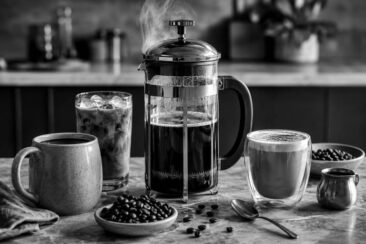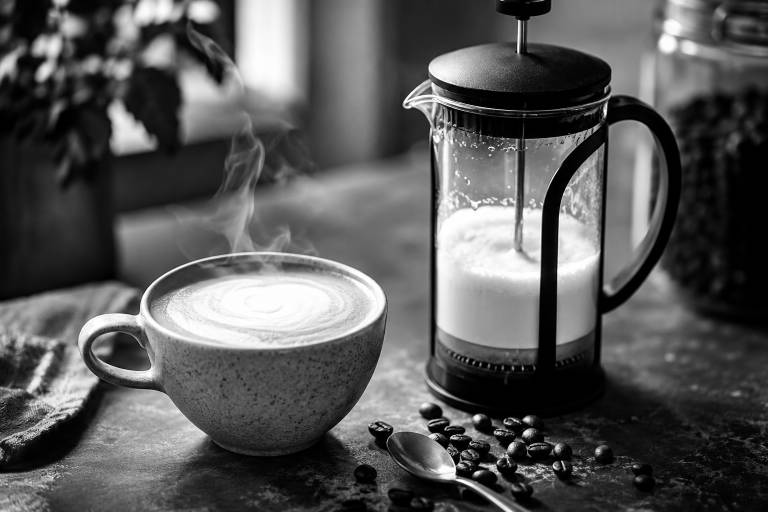
A french press can do more than brew your morning coffee.
It can produce a rich, creamy latte that rivals what you would get at a $6 coffee shop counter.
The secret is treating the french press as two tools in one: a coffee brewer and a milk frother.
With four tablespoons of coarse-ground coffee, a cup of warm milk, and about ten minutes of your time, you can pull together a latte with a velvety layer of foam right on your kitchen counter.
No espresso machine required, no barista training needed.
This guide walks through the full process of how to make a latte with a french press, from brewing the coffee concentrate to frothing the milk and assembling the final drink.
Quick Answer
Brew 4 tablespoons of coarse-ground coffee in your french press with 150 to 180 ml of hot water (about 200°F) for 4 minutes. Heat 1 cup of milk to about 150 to 160°F, pour it into the cleaned french press, and pump the plunger up and down for 20 to 30 seconds until the milk doubles in volume. Pour the coffee into a mug, add the frothed milk, and spoon foam on top.
Keep reading for milk type recommendations, flavor add-ins, and the most common mistakes that make a french press latte taste flat or bitter.
What Makes a French Press Latte Different from a Coffee Shop Version
A traditional latte starts with espresso, a concentrated shot pulled under 9 bars of pressure through finely ground coffee.
A french press cannot replicate that pressure.
Instead, the french press steeps coarse grounds in hot water for 4 minutes, producing a full-bodied concentrate that carries more natural oils than drip coffee or pour-over.
Those oils give the drink a thicker mouthfeel and a round, slightly buttery texture that blends well with steamed milk.
The other difference is the foam itself.
An espresso machine’s steam wand creates microfoam, tiny bubbles so fine they feel like silk on your tongue.
A french press plunger creates slightly larger bubbles, closer to a light mousse than true microfoam.
The result is less precise for latte art, more satisfying as a warm, frothy morning cup you can drink without fussing over pour angles.
Beginner Note A french press latte will not taste identical to a coffee shop espresso latte. It will taste richer, slightly heavier, and have a gentler foam. Many home brewers prefer this softer style once they try it.
Equipment and Ingredients for a French Press Latte
Gather everything before you start, so the coffee stays hot during the milk frothing step.
The full setup costs under $30 if you already own a french press.
| Item | Purpose | Notes |
|---|---|---|
| French press (12 oz or larger) | Brews coffee and froths milk | A 34 oz press works for 2 servings |
| Coarse-ground coffee | Creates the strong coffee base | Use dark roast or espresso roast for bolder flavor |
| Hot water | Brews the coffee | Target 195 to 205°F (just below boiling) |
| Milk (1 cup per serving) | Creates the latte body and foam | Whole milk froths best; oat milk is the top dairy-free pick |
| Thermometer (optional) | Checks milk temperature | Aim for 150 to 160°F |
| Sweetener or syrup (optional) | Adds flavor | Vanilla, caramel, honey, or cinnamon |
You do not need a separate milk frother, a handheld wand, or any electric gadget.
The french press plunger handles the frothing on its own.
How to Brew Strong Coffee for a French Press Latte
A latte needs a bold coffee base that can stand up to a full cup of milk without fading into the background.
Standard french press ratios (1:15 coffee to water) produce coffee that disappears once you add milk.
Use a tighter ratio of about 1:10 to 1:12 for latte brewing, which means roughly 4 tablespoons (28 grams) of coarse-ground coffee to 6 ounces (180 ml) of water.
Boil your water in a kettle, then let it rest for 30 seconds so it drops to about 200°F.
Pour the water over the grounds slowly, wetting them evenly, and stir once with a spoon.
Place the lid on without pressing the plunger, and set a timer for 4 minutes.
The aroma should shift from sharp and grassy to warm and roasted during those 4 minutes.
Press the plunger down slowly and steadily when the timer finishes.
Pour the coffee into your mug immediately so it does not continue extracting and turn bitter.
Quick Tip If you want a latte that tastes closer to a coffee shop espresso version, use espresso-roast beans ground on a medium-coarse setting. The darker roast punches through milk more than a light or medium roast will.
How to Froth Milk in a French Press
This is the step that surprises most people.
The same plunger that presses your coffee grounds can whip warm milk into thick, creamy foam in under a minute.
Step 1: Heat the milk.
Pour 1 cup of milk into a small saucepan over medium heat, or microwave it for 60 to 90 seconds.
You want the milk hot but not boiling, around 150 to 160°F.
Tiny bubbles will form along the edges of the pan right before it reaches the target temperature.
Step 2: Clean the french press.
Dump the coffee grounds, rinse the carafe quickly, and wipe the plunger screen.
Any remaining grounds will end up in your foam if you skip this step.
Step 3: Pour in the milk.
Fill the french press no more than one-third full.
The milk will double in volume during frothing, and overfilling leads to hot milk spilling over the top and onto your counter.
Step 4: Pump the plunger.
Hold the lid down firmly with one hand and pump the plunger up and down with the other.
Start slowly for the first 5 pumps, then increase your speed.
Continue for 20 to 30 seconds, or until the milk has visibly doubled in volume and feels thicker.
Step 5: Tap and swirl.
Remove the lid and gently tap the bottom of the french press on your counter twice.
Swirl the milk in a small circle to break up any large bubbles and blend the foam into a smoother texture.
The finished milk should look glossy and feel like melted ice cream when you pour it.
How to Assemble Your French Press Latte
Timing matters here.
The coffee cools fast once you pour it, and the foam starts to deflate after about two minutes, so move quickly through this step.
Pour the brewed coffee into a 12 to 16 ounce mug, filling it about one-third of the way.
Add any sweetener or flavored syrup now, before the milk goes in, and stir until it dissolves completely.
Hold back the foam with a spoon and pour the warm liquid milk over the coffee first.
Then spoon the remaining foam on top in a thick, soft layer.
A light dusting of cinnamon, cocoa powder, or nutmeg across the foam adds a warm, spiced scent that makes the whole drink feel more polished.
- [ ] Coffee brewed at a strong ratio (1:10 to 1:12)
- [ ] Milk heated to 150 to 160°F
- [ ] French press rinsed before frothing
- [ ] Milk pumped until doubled in volume
- [ ] Sweetener stirred into coffee before adding milk
- [ ] Foam spooned on top as the final layer
Best Milk for a French Press Latte
The milk you choose changes the taste, texture, and quality of the foam more than any other single variable.
Whole milk is the gold standard for frothing, and its balance of fat (about 3.5%) and protein creates a stable, creamy foam with tiny bubbles.
The natural sugars in whole milk caramelize slightly when heated, adding a subtle sweetness that rounds out the coffee’s bitterness without extra sugar.
Two-percent milk works almost as well, producing a slightly lighter foam that most people cannot distinguish from whole milk in a blind taste.
| Milk Type | Foam Quality | Flavor Notes | Best For |
|---|---|---|---|
| Whole milk | Thick, creamy, stable | Sweet, buttery | Classic latte, beginners |
| 2% milk | Slightly lighter, still stable | Mild, clean | Lighter latte, everyday use |
| Oat milk (barista blend) | Smooth, stable | Mild sweetness, cereal-like | Dairy-free latte |
| Almond milk | Thin, less stable | Nutty, light | Iced lattes, lower calorie |
| Soy milk | Good foam, can curdle | Neutral, beany | High-protein option |
If you are using a plant-based milk, buy the barista blend version.
Standard grocery-shelf oat or almond milk often lacks the added fats and stabilizers needed to hold foam.
Barista blends from brands like Oatly, Califia Farms, or Pacific Barista Series froth far more consistently and resist separating in hot coffee.
Common Mistake Heating milk past 180°F will scald it, creating a flat, chalky taste and killing the foam. Pull the milk off the heat the moment you see steam or small bubbles at the edges.
Flavor Add-Ins That Turn a Simple Latte into a Cafe Drink
A plain french press latte tastes clean and satisfying on its own, with the dark warmth of coffee softened by smooth milk foam.
Adding a syrup or spice transforms it into something you would expect to see on a menu board, for a fraction of what a coffee shop charges.
Vanilla latte: Add 1 tablespoon of vanilla syrup or half a teaspoon of pure vanilla extract to the coffee before pouring in the milk.
Mocha latte: Stir 1 tablespoon of cocoa powder and 1 teaspoon of sugar into the hot coffee until dissolved, then add the frothed milk.
Caramel latte: Drizzle 1 tablespoon of caramel sauce into the mug, pour the coffee over it, stir, and top with frothed milk and an extra caramel drizzle.
Cinnamon latte: Add half a teaspoon of ground cinnamon to the coffee grounds before brewing, so the spice infuses directly into the concentrate.
Honey latte: Stir 1 tablespoon of honey into the hot coffee until fully dissolved, then add the milk and foam.
A 12-ounce vanilla latte at a major chain costs roughly $5.50 to $6.50 in 2026.
The homemade version uses about $0.40 worth of coffee, $0.30 of milk, and $0.15 of syrup, bringing the total to under $1.00 per cup.
Common Mistakes That Ruin a French Press Latte
A few small errors can turn what should be a creamy, smooth latte into something thin, bitter, or lukewarm.
Brewing the coffee too weak.
A standard 1:15 ratio produces a mellow cup, but that same coffee tastes watered down once you add 8 ounces of milk.
Use a 1:10 to 1:12 ratio so the coffee flavor punches through the milk.
Overfilling the french press with milk.
Hot milk expands fast when you pump the plunger.
Fill the press only one-third full, or you will have a sticky, milky mess on your hands and countertop.
Frothing cold milk.
Cold milk froths into large, unstable bubbles that deflate within seconds.
Always heat the milk to 150 to 160°F before frothing, and the foam will hold its shape for 3 to 5 minutes.
Not cleaning the press between brewing and frothing.
Leftover coffee grounds stick to the plunger screen and end up floating in your foam.
A quick rinse under hot water takes 15 seconds and saves the texture of the entire drink.
| Mistake | What Happens | Fix |
|---|---|---|
| Coffee too weak | Milk overpowers the coffee flavor | Use a 1:10 to 1:12 brew ratio |
| Milk too hot (above 180°F) | Scalded, flat, chalky taste | Heat to 150 to 160°F only |
| Press overfilled with milk | Milk spills during frothing | Fill only one-third of the press |
| Grounds not rinsed out | Gritty bits in the foam | Rinse press and screen before frothing |
| Waiting too long to assemble | Cold coffee, deflated foam | Pour and assemble within 2 minutes |
French Press Latte vs. Cappuccino vs. Flat White
All three drinks start with strong coffee and frothed milk, but the ratios and textures set them apart.
A latte uses the most milk of the three, with a ratio of about 1 part coffee to 4 parts steamed milk and a thin layer of foam on top.
The result is a smooth, mild, milky drink where the coffee flavor sits in the background.
A cappuccino uses equal parts coffee, steamed milk, and foam (roughly 1:1:1), producing a stronger coffee taste and a thick, airy foam cap.
A flat white falls between the two, with less milk than a latte but a thinner, silkier foam than a cappuccino.
You can approximate all three with a french press by adjusting how much milk you add and how long you froth.
For a french press cappuccino, brew the same strong coffee but use only half a cup of milk and pump the plunger longer (40 to 60 seconds) to build a stiffer, thicker foam.
For a french press flat white, use about three-quarters of a cup of milk and pump for only 10 to 15 seconds, creating a very thin layer of velvety foam rather than a thick cap.
The taste difference between these three drinks comes down to how much coffee flavor you can sense through the milk.
Quick Tip The less milk you add, the more the coffee flavor dominates. If your first french press latte tastes too milky, try reducing the milk by 2 ounces and see how the balance shifts.
How to Make an Iced Latte with a French Press
Summer heat calls for cold coffee, and the french press handles iced lattes with one small adjustment.
Brew the coffee at an even stronger ratio (1:8 or about 4 tablespoons of coffee to 4 ounces of water), since the ice will dilute the concentrate as it melts.
Let the brewed coffee cool for 5 minutes on the counter, or pour it directly over a full glass of ice to chill it instantly.
Cold milk does not need to be frothed for an iced latte, but you can create cold foam if you prefer it.
Pour cold milk into the french press (no heating needed) and pump the plunger vigorously for 30 to 45 seconds.
The foam will be lighter and fluffier than warm foam, sitting like a pale cloud on top of the glass.
Pour your cold milk over the iced coffee, spoon the cold foam on top, and add a straw.
The finished drink should have distinct layers you can see through a clear glass: dark coffee at the bottom, lighter milk in the middle, white foam on top.
How Much a French Press Latte Saves You Over Coffee Shops
A daily coffee shop latte adds up faster than most people expect.
At $5.75 per drink (the average price for a medium latte at a major U.S. chain in 2026), five lattes per week costs $28.75, or about $1,495 per year.
A french press costs between $15 and $35 for a quality glass or stainless steel model.
A 12-ounce bag of good espresso-roast beans runs about $12 to $16 and makes roughly 20 to 25 lattes.
A gallon of whole milk costs about $4 and covers 15 to 16 lattes.
That puts each homemade latte somewhere between $0.75 and $1.10, depending on the beans and milk you choose.
Switching to a french press latte five days a week saves roughly $1,200 per year, enough to buy a weekend trip, a new piece of furniture, or (if you are like most coffee lovers) a very nice bag of single-origin beans every month.
The savings only grow if you add flavored syrups at home instead of paying the $0.50 to $0.80 upcharge a coffee shop tacks on per pump.
A 750 ml bottle of vanilla or caramel syrup costs about $8 to $12 and lasts for 25 to 50 drinks, compared to $0.50 or more per pump at a cafe.
Your Next Step After Your First French Press Latte
Once you have made a few plain lattes and feel comfortable with the frothing rhythm, start experimenting with the variables.
Try a medium roast instead of a dark roast and notice how the latte takes on brighter, fruitier notes.
Swap whole milk for a barista oat milk and pay attention to the way the sweetness changes.
Add the cinnamon directly to the grounds instead of dusting it on top, and taste how much deeper the spice flavor reaches into the cup.
A french press latte is not a lesser version of the real thing.
It is a different path to the same destination: a warm, creamy, satisfying cup of coffee and milk that smells like roasted caramel, feels like velvet, and costs less than a dollar.