Every great french press coffee starts with the right amount of coffee and the right amount of water.
Get that ratio wrong, and you end up with a cup that tastes thin, sour, and forgettable, or one that hits your tongue like a bitter wall.
The french press coffee to water ratio controls everything you taste in the cup: strength, body, sweetness, and how much of the bean’s natural flavor actually comes through.
A digital kitchen scale costing less than $15 removes all the guesswork from your morning routine.
This guide gives you exact gram measurements, tablespoon conversions, and a clear framework for adjusting the ratio to match your beans, your roast level, and your personal taste.
Quick Answer
The standard french press coffee to water ratio is 1:15, meaning 1 gram of coffee for every 15 grams of water. For a standard 4-cup (500 ml) press, that works out to 33 grams of coarsely ground coffee and 500 grams of water.
If you prefer a stronger cup, try 1:12. For something lighter, try 1:17.
Keep reading for exact measurements at every press size, roast-level adjustments, and the most common ratio mistakes that lead to bad-tasting coffee.
What Does the French Press Coffee to Water Ratio Mean?
The ratio is simply how much coffee you use compared to how much water you pour.
A 1:15 ratio means that for every 1 gram of ground coffee, you add 15 grams (or milliliters) of water.
Higher numbers on the water side (1:17, 1:18) produce a lighter, more delicate cup.
Lower numbers (1:12, 1:13) produce a thicker, more concentrated brew with a heavier mouthfeel.
The french press is an immersion brewer, which means your coffee grounds sit fully submerged in hot water for the entire steep time.
That full-contact brewing pulls more oils, more dissolved solids, and more body into your cup than a paper-filtered method ever could.
Beginner Note If you are brand new to brewing with a french press, start with 1:15. It gives you a balanced, forgiving cup that works well with most grocery store and specialty beans.
Exact Measurements for Every French Press Size
Tablespoon counts are helpful when you do not have a scale, but they are only approximate.
One level tablespoon of ground coffee weighs about 5 grams, and that number shifts depending on roast level and grind size.
Darker roasts are less dense, so a tablespoon of dark roast weighs slightly less than a tablespoon of light roast.
| French Press Size | Water | Coffee (1:15) | Tablespoons (approx.) | Cups It Makes |
|---|---|---|---|---|
| 3-cup / 350 ml (12 oz) | 350 g | 23 g | 4.5 tbsp | 1 mug |
| 4-cup / 500 ml (17 oz) | 500 g | 33 g | 6.5 tbsp | 2 small mugs |
| 8-cup / 1,000 ml (34 oz) | 1,000 g | 67 g | 13 tbsp | 4 small mugs |
| 12-cup / 1,500 ml (51 oz) | 1,500 g | 100 g | 20 tbsp | 6 small mugs |
A standard coffee scoop holds about 10 grams, or roughly two tablespoons.
For consistent results every single time, weigh your coffee and water with a digital scale.
Volumetric measurements like scoops and tablespoons introduce enough variance from cup to cup that your coffee can taste noticeably different each morning.
How the 1:15 Ratio Compares to Other Common Ratios
Not every ratio works the same way in a french press.
The Specialty Coffee Association (SCA) Golden Cup Standard recommends 55 grams of coffee per liter of water, which translates to roughly a 1:18 ratio.
That standard was built around drip and batch brewers, where water passes through the grounds once and moves on.
In a french press, water sits with the grounds for 4 full minutes, extracting more aggressively.
Using the SCA’s 1:18 ratio in a french press often produces a cup that tastes flat and underpowered, especially with light-roasted beans.
| Ratio | Strength | Flavor Profile | Best Suited For |
|---|---|---|---|
| 1:12 | Bold | Thick body, intense, creamy mouthfeel | Dark roast fans who want a strong morning kick |
| 1:14 | Medium-strong | Full body with clear flavor detail | Medium-dark roasts, cold mornings |
| 1:15 | Balanced | Smooth body, fruit and sweetness come through | Most coffees, the safest starting point |
| 1:17 | Light | Thinner body, more tea-like clarity | Delicate light roasts, afternoon cups |
| 1:18 | Very light | Can taste watery or flat in a french press | SCA drip standard, less common for immersion |
Quick Tip If you are switching from drip coffee to a french press for the first time, start at 1:15. You will immediately notice a heavier body and more richness in the cup compared to what a paper filter produces.
How Roast Level Changes Your Ideal Ratio
Dark roasts and light roasts do not extract the same way, and your ratio should reflect that.
Dark roasts have a more porous, brittle cell structure from longer roasting times.
They dissolve flavors into water quickly and easily, which means they can taste harsh or ashy if you use too much coffee.
A 1:15 or 1:16 ratio keeps a dark roast rich and smooth without crossing into bitterness.
Light roasts are denser, harder beans that need a bit more coaxing to release their sugars and acids.
A 1:14 or 1:15 ratio gives light roasts enough coffee concentration to bring out their bright acidity, fruit notes, and floral aromas.
At 1:18, the same light roast can taste thin, sour, and underdeveloped.
Medium roasts sit right in the sweet spot where 1:15 almost always works.
This is the reason most brew guides default to 1:15 as the universal starting point for french press.
- Dark roast: 1:15 to 1:16
- Medium roast: 1:15
- Light roast: 1:14 to 1:15
Why Grind Size and Ratio Work Together
Changing your ratio without thinking about grind size is like adjusting the seasoning on a dish without checking the cooking temperature.
The standard recommendation for french press is a coarse grind, similar in texture to sea salt or raw sugar.
Coarse grounds have less surface area exposed to the water, so extraction happens more slowly across the 4-minute steep.
Grind too fine, and the water rips through the coffee’s compounds too fast, pulling out bitter tannins and astringent notes that make you wince.
Fine grounds slip through the mesh filter, filling your cup with muddy sediment that keeps extracting long after you press.
Grind too coarse, and the water barely scratches the surface of each coffee particle, leaving you with a sour, thin, lifeless cup.
The plunger glides down with almost no resistance when the grind is too coarse, and that lack of friction is your signal to tighten things up.
Do / Don’t
- Do aim for grounds that look and feel like coarse sea salt between your fingers.
- Do invest in a burr grinder for uniform particle size. Even a $40 hand burr grinder outperforms an expensive blade grinder for french press.
- Don’t use pre-ground drip coffee in a french press without shortening the steep time to about 2 minutes, 30 seconds.
- Don’t change your grind size and your ratio at the same time. Adjust one variable per brew so you can tell what actually changed the flavor.
Water Temperature: The Invisible Ingredient
Water makes up about 98.5% of your finished cup, and its temperature controls how fast flavor compounds dissolve out of the grounds.
The ideal range for french press brewing is 195°F to 205°F (90°C to 96°C).
The simplest way to reach that range: bring your kettle to a full boil, then let it sit for 30 seconds before pouring.
Water that is too hot scorches the grounds and pulls out sharp, bitter compounds you do not want.
Water that is too cool under-extracts, leaving acids stranded in the grounds and producing a flat, sour cup.
Roast level matters here, too.
For dark roasts, drop your temperature to the lower end of the range, around 185°F to 195°F (85°C to 90°C), to avoid amplifying bitterness.
For light roasts, stay closer to 205°F (96°C) or even just off the boil to coax out the full spectrum of sugars and aromatics locked inside those dense beans.
Common Mistake Pouring boiling water straight from the kettle onto your grounds is one of the fastest ways to ruin good coffee. That 30-second wait after boiling costs you nothing and protects the flavor of every cup.
How to Brew a Standard French Press in 5 Steps
This is the classic method that produces a full-bodied, rich cup in about 4 minutes and 30 seconds of total time.
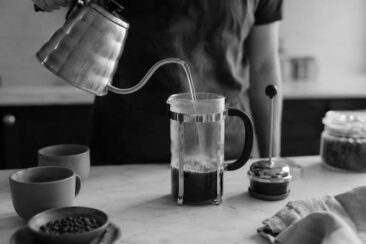
Step 1: Preheat the french press by pouring hot water into the empty carafe and swirling it around for a few seconds, then discard the water.
Step 2: Weigh out 33 grams of coarsely ground coffee (for a 500 ml press) and add it to the carafe.
Step 3: Start a timer and pour 500 grams of hot water (195°F to 205°F) over the grounds in a steady stream, making sure all the coffee gets wet.
Step 4: Give the slurry one gentle stir with a spoon to break up any dry clumps on the surface, then set the lid on top with the plunger pulled all the way up.
Step 5: At 4 minutes, press the plunger down slowly and steadily, then pour the coffee into your mug immediately.
Do not leave brewed coffee sitting in the press.
The grounds at the bottom keep extracting, and within minutes your second cup will taste noticeably more bitter than your first.
The James Hoffmann French Press Technique
James Hoffmann, the 2007 World Barista Champion, popularized a longer method that produces a cleaner, less silty cup from the same brewer.
His recipe calls for 30 grams of coffee to 500 grams of water, a ratio of roughly 1:16.7.
He recommends a medium to medium-coarse grind rather than the traditional coarse setting.
The total brew time stretches to about 9 to 12 minutes, but the result is a cup with dramatically less sediment and a lighter, sweeter flavor.
After pouring all the water in at once, let the coffee sit untouched for 4 minutes.
A thick crust of grounds forms on the surface during this time.
Break the crust gently with a spoon, stirring just 2 or 3 times to help the grounds sink.
Scoop off any foam and floating particles with two spoons, then set the press aside for another 5 to 8 minutes.
When you are ready to pour, push the plunger down only to the surface of the liquid, not to the bottom.
The plunger acts as a strainer, not a press, holding back floating debris without disturbing the settled grounds below.
Pour slowly and carefully.
The coffee at the very bottom of the carafe is full of fine sediment, so leave the last half-inch behind.
How Caffeine Content Changes with Your Ratio
An 8-ounce cup of french press coffee contains roughly 80 to 135 milligrams of caffeine, with most cups landing around 100 to 107 mg.
That puts it in the same range as standard drip coffee, which averages about 95 mg per 8-ounce serving.
Your ratio directly affects how much caffeine ends up in your cup.
A stronger 1:12 ratio uses more coffee per serving, which means more total caffeine extracted into the water.
A lighter 1:18 ratio uses less coffee, bringing the caffeine level down proportionally.
| Ratio | Coffee per 8 oz Cup | Estimated Caffeine |
|---|---|---|
| 1:12 | ~20 g | 110 to 135 mg |
| 1:15 | ~16 g | 90 to 110 mg |
| 1:18 | ~13 g | 75 to 95 mg |
Light roast beans contain slightly more caffeine by weight than dark roasts, since the longer roasting process burns off a small amount of caffeine.
The difference is modest, though.
Your ratio and the total amount of coffee you use have a much bigger impact on caffeine than roast level alone.
Troubleshooting Common French Press Ratio Problems
Your taste buds are the best diagnostic tool you have.
If your coffee tastes weak or watery, you are most likely using too little coffee for the amount of water. Increase your dose by 2 to 3 grams and try again.
If adding more coffee does not fix it, check your grind.
Grounds that are too coarse let water slide past without extracting enough flavor.
If your coffee tastes bitter or harsh, the most common culprits are a grind that is too fine, water that is too hot, or a steep time that ran too long.
Pull back the steep to exactly 4 minutes, let your water cool for 30 seconds after boiling, and make sure your grounds look like coarse sea salt rather than fine sand.
Leaving brewed coffee sitting on the grounds after pressing is a sneaky source of bitterness that catches many people off guard.
If your coffee tastes sour or sharp, the brew is under-extracted.
Try grinding slightly finer, raising your water temperature by a few degrees, or extending the steep by 30 seconds.
If the flavor is close but not quite right, change only one variable per brew.
Adjusting your grind, ratio, water temperature, and steep time all at once tells you nothing about what actually fixed the problem.
Grind size is the most sensitive variable, so start there.
Scales, Scoops, and Why Precision Matters
A $12 digital kitchen scale is the single best upgrade most french press brewers can make.
Coffee density varies by roast level, origin, and grind size, which means a “tablespoon” of one coffee can weigh 4 grams and a tablespoon of another can weigh 6 grams.
That 2-gram swing adds up fast across 6 or 7 tablespoons, sometimes producing a cup that is 30% stronger or weaker than what you intended.
Weighing your coffee and water removes that inconsistency.
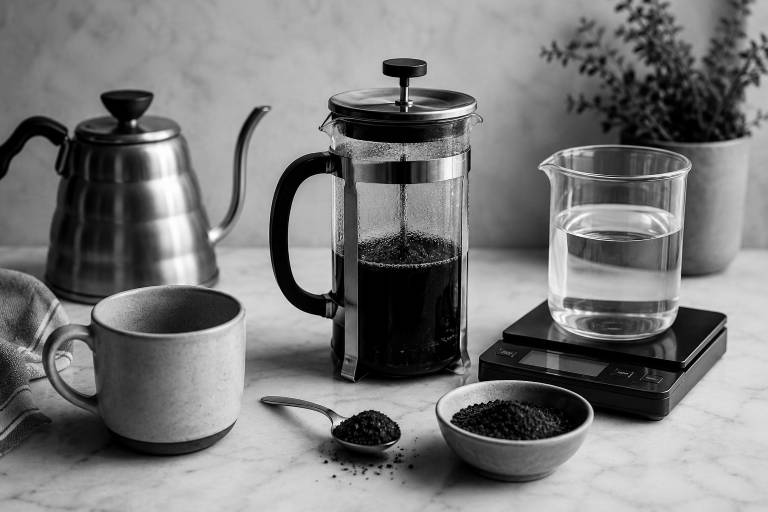
Place the french press on the scale, tare it to zero, add your ground coffee, note the weight, tare again, and pour water until you reach your target number.
The entire weighing process takes about 15 seconds.
A scale that reads in 0.1-gram increments is ideal for pour-over and espresso, but a basic kitchen scale that reads in whole grams works perfectly fine for french press brewing.
Your morning coffee routine should feel like a small comfort, not a chemistry exam.
The ratio gives you the framework, and your taste gives you the final answer.
Start at 1:15, brew a cup, and pay attention to how it lands on your tongue.
If it is too light, drop to 1:14 next time.
If it is too heavy, move up to 1:16.
Within a few mornings, you will know your number, and your french press will reward you with the best cup of coffee in the house.