Your french press grind size is the single biggest reason your coffee tastes great or terrible.
Grind too fine, and you get a muddy, bitter cup with sludge coating the bottom of your mug.
Grind too coarse, and the result is thin, sour, and underwhelming, like coffee-flavored water.
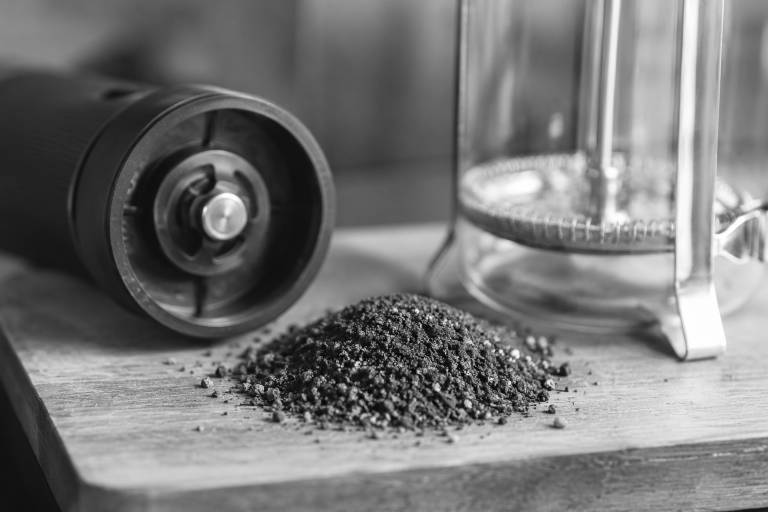
The sweet spot sits right in the middle of coarse territory, where each particle looks and feels like a grain of sea salt.
Getting that french press grind size right takes less effort than most people expect, and the difference in flavor is impossible to miss after your first correctly dialed-in cup.
This guide covers the exact grind settings for popular grinders, the science behind why particle size matters so much, a tested 4-minute brewing recipe, and practical fixes for every common french press problem.
Quick Answer
The ideal french press grind size is coarse, around 800 to 1,000 microns, with particles that look like coarse sea salt or cracked peppercorns. On a Baratza Encore, that means settings 28 to 32. Pair it with a 1:15 coffee-to-water ratio, water at 200°F, and a 4-minute steep.
If your coffee is bitter, grind coarser. If it is sour, grind finer. Keep reading for grinder settings, troubleshooting tips, and two full brewing methods.
Why French Press Grind Size Controls Your Coffee’s Flavor
Every time hot water touches ground coffee, it starts dissolving flavor compounds in a specific sequence.
Acids come out first, bringing bright, fruity notes.
Sugars follow, adding sweetness and body.
Bitter compounds like chlorogenic acid lactones arrive last, and they show up fast when the grind is too fine.
Finer particles expose more surface area to the water, which speeds up extraction and pulls those harsh bitter notes into your cup well before the 4-minute steep is finished.
Coarser particles slow the process down, giving the water time to pull sweetness and body without racing past the good flavors into astringent, ashy territory.
A 2020 study published in Nature Scientific Reports confirmed this relationship, showing that smaller grind particles extract significantly more dissolved compounds in the same time window.
Common Mistake Grinding too fine is the number one cause of bitter, harsh french press coffee. If your cup tastes like burnt toast or leaves a dry feeling on your tongue, your grind is almost certainly too fine.
The french press magnifies the effects of grind size more than most other brewing methods.
Its metal mesh filter cannot catch tiny particles the way a paper filter can, so any fine dust in your grind passes right through into the cup.
Those fines keep extracting flavor compounds even after you push the plunger down, which is where the classic “over-brewed” bitterness comes from.
What the Right French Press Grind Looks and Feels Like
Pinch a small amount of properly ground french press coffee between your thumb and forefinger.
It should feel gritty and rough, similar to coarse sea salt or kosher salt.
The particles should be clearly visible as individual pieces, not clumped together or powdery.
Spread a tablespoon of grounds on a white plate and look at them closely.
Each grain should be about the size of a sesame seed, roughly 1.0 mm across according to Specialty Coffee Association guidelines.
If the grounds look like fine sand or table salt, they are too small for a french press.
If they look like small pebbles or cracked corn kernels, they are too large and will produce a weak, hollow cup.
Do / Don’t
- Do look for distinct, separate particles with visible texture
- Do compare the feel to coarse sea salt or cracked peppercorns
- Don’t use grounds that feel smooth, powdery, or flour-like
- Don’t accept a grind where you see a mix of dust and large chunks together
French Press Grind Settings for Popular Grinders
Every grinder uses a different numbering system, so “coarse” looks different on each dial.
These settings are tested starting points, not final answers.
Brew a cup, taste it, then adjust by 2 clicks in either direction based on what you find in the cup.
| Grinder | French Press Setting | Adjustment Notes |
|---|---|---|
| Baratza Encore | 28 to 32 | Start at 30; go coarser for dark roasts |
| Baratza Virtuoso+ | 28 to 32 | Same burr set as the Encore |
| Fellow Ode Gen 2 | 9 to 11 | Flat burrs produce fewer fines at this range |
| 1Zpresso K-Pro | 90 to 110 clicks | Count from zero; each click shifts 0.022 mm |
| Comandante C40 | 28 to 32 clicks | From zero; a popular travel hand grinder |
| Timemore C2/C3 | 22 to 28 clicks | Budget-friendly hand grinder |
| Hario Skerton Pro | 6 to 7 full turns | From the finest setting |
| Breville Smart Grinder Pro | 50 to 55 | Out of 60 total settings |
If your grinder has a french press icon on the dial, start there and fine-tune from that position.
For any unlisted model, set the grinder near its coarsest option and work 2 to 3 notches finer until the coffee tastes balanced.
Why a Burr Grinder Beats a Blade Grinder for French Press
A blade grinder spins a metal propeller at high speed, chopping beans into random pieces.
Some of those pieces end up as fine dust, and others stay as large chunks.
When you brew with that uneven mix, the dust over-extracts in seconds, yet the chunks barely release any flavor at all.
The result is a cup that manages to taste bitter and weak at the same time, a muddy contradiction that no amount of tweaking can fix.
A burr grinder crushes beans between two abrasive surfaces set a precise distance apart.
Every particle comes out close to the same size, which means the water extracts evenly across the entire dose.
Quick Tip If you are spending $15 on quality beans but grinding them with a $20 blade grinder, the grinder is canceling out most of that investment. A $40 to $80 hand burr grinder like the Hario Skerton Pro or Timemore C3 will change the flavor of your french press coffee more than any other single upgrade.
Uniform grind is the foundation of a clean, balanced french press cup.
Every other variable, including water temperature, steep time, and coffee dose, becomes easier to control once your grind consistency is solid.
How Roast Level Changes Your French Press Grind Setting
Dark roasted beans are softer and more porous than light roasts.
Water penetrates them faster and pulls out flavor compounds with less resistance, which means they extract more quickly at the same grind size.
Light roasts are denser, harder, and more tightly structured at the cellular level.
They need more time, more heat, or a finer grind to give up the same amount of flavor.
For french press brewing, this means you should grind slightly coarser for dark roasts and slightly finer for light roasts, adjusting by about 2 notches on your grinder’s dial.
Medium roasts sit right in the sweet spot of most standard french press settings, which is why they are the most forgiving choice for this brewing method.
On a Baratza Encore, a practical starting framework looks like this:
- Light roast: Setting 28 to 29
- Medium roast: Setting 30
- Dark roast: Setting 31 to 32
The aroma will tell you a lot during brewing.
A light roast steeped at the right grind releases a bright, floral smell, almost tea-like.
A medium roast fills the room with warm chocolate and caramel notes.
A dark roast pushes toasted, smoky richness into the air above the press.
The Standard 4-Minute French Press Recipe
This recipe works as a reliable baseline for any coarse grind.
Once you taste the result, you can adjust one variable at a time to match your preferences.
What you need:
- 30 grams of coarsely ground coffee (about 5 tablespoons)
- 450 grams of water heated to 200°F (93°C)
- A french press
- A timer
Steps:
- Pour hot water into the empty press to warm the glass, then dump it out
- Add 30 grams of coarse grounds to the press
- Start your timer and pour 450 grams of water over the grounds, making sure every particle gets wet
- Place the lid on with the plunger pulled up and wait 4 minutes
- Press the plunger down slowly and steadily
- Pour all the coffee into your mug or a carafe right away
Decant immediately after pressing. Coffee left sitting on the grounds continues to extract, and within a few minutes it will turn bitter and harsh.
The 1:15 ratio (30 grams of coffee to 450 grams of water) produces a balanced, medium-strength cup.
For a stronger brew, push to 1:14 by using 32 grams of coffee with the same water volume.
For a lighter cup, drop to 1:16 or 1:17 by reducing the coffee dose to 27 or 26 grams.
The James Hoffmann Method for a Cleaner Cup
World Barista Champion James Hoffmann popularized a modified french press technique that produces noticeably less sediment and a smoother mouthfeel than the standard approach.
The method adds about 5 extra minutes to the process, and the payoff is a cup that feels closer to pour-over clarity with the full body of immersion brewing.
Hoffmann’s approach:
- Grind 30 grams of coffee at a medium-coarse setting, slightly finer than traditional french press
- Pour 500 grams of boiling water directly over the grounds
- Wait 4 minutes without touching anything
- Break the crust of floating grounds gently with a spoon, then scoop off any foam and remaining floating bits
- Wait another 5 to 6 minutes for the grounds to settle to the bottom
- Place the plunger on the surface of the liquid and press down only until it reaches the top of the coffee, not all the way to the bottom
- Pour carefully without disturbing the settled bed of grounds
Beginner Note The Hoffmann method uses a slightly finer grind than traditional french press recipes. If you normally brew at setting 30 on a Baratza Encore, try setting 26 to 28 for this technique. The longer total steep time and gentler pressing compensate for the finer particles.
The biggest difference you will notice is texture.
Traditional french press coffee has a thick, almost silty mouthfeel that coats your tongue.
Hoffmann’s method strips away most of that sediment but keeps the rich, oily body that makes french press coffee distinct.
How to Fix Bitter, Sour, or Muddy French Press Coffee
Tasting your coffee and knowing what to adjust is the fastest path to a better cup.
Each off-flavor points to a specific fix, and you should change only one variable at a time so you know what actually made the difference.
| Problem | What It Means | Fix |
|---|---|---|
| Bitter, ashy, or harsh | Over-extraction | Grind 2 to 3 notches coarser, or shorten steep to 3:30 |
| Sour, sharp, or thin | Under-extraction | Grind 2 notches finer, or extend steep to 4:30 |
| Muddy with heavy sludge | Grind too fine, pressed too hard | Grind coarser and press the plunger down gently |
| Weak and watery | Not enough coffee, or grind too coarse | Add more coffee (try 1:14 ratio) or grind 1 to 2 notches finer |
| Bitter AND sour at once | Uneven grind (blade grinder) | Switch to a burr grinder for uniform particles |
A bitter cup almost always means the coffee spent too long extracting, or the grind exposed too much surface area.
A sour cup means not enough extraction happened, either from a grind that was too coarse, water that was too cool, or a steep that ended too soon.
If you taste something that is somehow bitter and sour at the same time, uneven grind consistency is the usual cause.
Can You Use Pre-Ground Coffee in a French Press?
Yes, and millions of people do it every morning.
Pre-ground coffee from the grocery store is ground for automatic drip machines, which means it sits at a medium setting, finer than what a french press works best with.
That finer grind will over-extract in a standard 4-minute steep and slip through the mesh filter, leaving more sludge in your cup.
You can compensate for this by making three adjustments:
- Shorten the steep time to 2.5 to 3 minutes instead of the full 4
- Use slightly cooler water, around 185°F to 190°F, to slow down extraction
- Press the plunger very slowly to minimize the amount of fine particles that push through the filter
These adjustments will not produce the same clean cup you get with freshly ground coarse beans, but they will get you a solid, drinkable brew that avoids the worst bitterness.
Ground coffee loses its aromatic compounds quickly after grinding.
If you buy pre-ground, store it in an airtight container and use it within two weeks for the best flavor.
Water Temperature and Ratio: The Other Two Variables That Matter
Grind size gets the most attention, and for good reason, but water temperature and the coffee-to-water ratio work alongside it to determine what ends up in your cup.
Water temperature for french press should land between 195°F and 205°F (90°C to 96°C).
The Specialty Coffee Association recommends this range for balanced extraction across all hot brewing methods.
Water straight off a rolling boil sits at 212°F, which is slightly above the ideal range.
Letting the kettle rest for 30 to 60 seconds after boiling brings it into the right zone for most coffees.
If you do not own a thermometer or a variable-temperature kettle, that 30 to 60 second rest is a reliable shortcut.
Water that is too hot pulls out bitter tannins and astringent compounds faster than the brewing time can manage.
Water that is too cool leaves sugars and oils locked inside the grounds, producing a flat, sour cup.
For dark roasts, err on the cooler side of the range (190°F to 195°F) to keep the brew smooth.
For light roasts, stay near the top of the range (200°F to 205°F) to coax out their sweetness and complexity.
| Variable | Standard Setting | Stronger Cup | Lighter Cup |
|---|---|---|---|
| Coffee-to-water ratio | 1:15 | 1:13 to 1:14 | 1:16 to 1:17 |
| Water temperature | 200°F (93°C) | 200°F (93°C) | 200°F (93°C) |
| Steep time | 4 minutes | 4 minutes | 3:30 |
| Grind size | Coarse | Coarse | Coarse |
How to Reduce Sediment and Sludge in Your Cup
Some sediment is a normal and expected part of french press coffee.
The metal mesh filter lets through small particles and coffee oils that a paper filter would trap, and that is actually what gives french press its signature thick, velvety body.
Still, there is a difference between pleasant body and gritty sludge that coats your teeth.
If the sediment in your cup crosses that line, five fixes will help.
Grind coarser. Larger particles are less likely to pass through the mesh, and they produce fewer fine dust particles during grinding.
Break the crust after steeping. After 4 minutes, a layer of grounds floats on the surface. Use a spoon to stir gently, then scoop off the foam and floating debris. This is the step from the Hoffmann method that makes the most dramatic difference in cup clarity.
Press the plunger slowly. Pushing down hard and fast forces fine particles through the mesh screen. Let the weight of your hands do the work.
Wait before pouring. After pressing, let the coffee sit for 30 seconds so the remaining fines settle to the bottom. The first pour from the press will be cleaner than the last pour.
Stop before the bottom. Leave the last half-inch of liquid in the press. That final layer carries the heaviest concentration of sediment.
The smell of a properly brewed, low-sediment french press cup should hit you before the mug reaches your lips: warm, round, slightly sweet, with none of the acrid sharpness that comes from over-extracted fines.