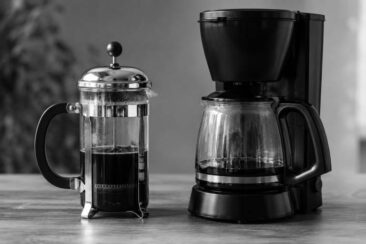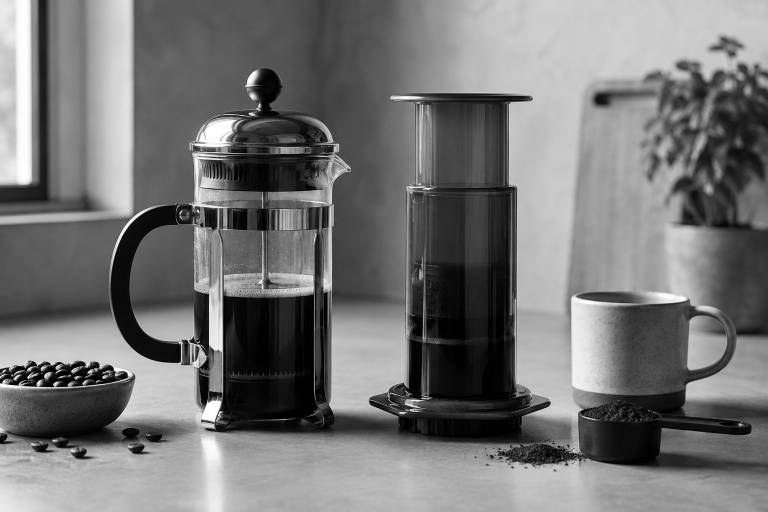
The french press vs AeroPress debate comes down to one question: do you want a thick, oily cup or a clean, bright one?
These two manual brewers share the same immersion brewing DNA, steeping coffee grounds in hot water before filtering.
The french press vs AeroPress difference shows up the moment you take your first sip, with body, acidity, and clarity pulling in opposite directions.
This french press vs AeroPress comparison covers grind size, brew time, flavor, cost, cleanup, and portability so you can pick the right brewer with confidence.
Quick Answer
The French press makes full-bodied coffee with natural oils and some sediment, using a coarse grind and a 4-minute steep. The AeroPress brews a cleaner, brighter cup through a paper filter in under 2 minutes. Pick the French press for sharing and bold flavor, or the AeroPress for solo cups, travel, and lower acidity.
How These Two Brewing Methods Actually Work
Every cup from these two brewers starts the same way: ground coffee sitting in hot water.
That shared approach puts them in the same family of immersion brewing, where water and grounds steep together rather than dripping through a filter bed.
The French press keeps things simple, with coarse grounds steeping in a glass or steel carafe for about 4 minutes before a metal mesh plunger pushes the grounds to the bottom.
What stays in the cup is everything the mesh cannot catch, including coffee oils, microscopic particles, and the thick mouthfeel that French press fans love.
A first patent for the French press concept dates back to 1852, when French inventors Mayer and Delforge filed their design, and the modern version took shape through Italian and Swiss refinements over the following century.
Stanford engineering instructor Alan Adler invented the AeroPress in his Palo Alto garage, and the brewer debuted at Coffee Fest Seattle in November 2005.
His design adds air pressure to the equation, using a syringe-like plunger to push water through the grounds and a paper filter in about 60 to 90 seconds.
That paper filter traps nearly all oils and sediment, producing a cup that looks and tastes dramatically different from its older cousin.
The french press vs AeroPress split begins right here, at the filter: metal mesh lets everything through, paper catches everything.
Choosing between a paper filter and a metal filter is the single biggest factor shaping your cup in the french press vs AeroPress decision.
Beginner Note The AeroPress comes with 350 paper microfilters in the box. Reusable metal disc filters are available from third-party brands, and they shift the cup closer to a French press texture by letting oils pass through.
Grind Size and Why It Changes the Cup
The grind you use separates a great cup from a bitter mess faster than any other variable in the french press vs AeroPress equation.
French press coffee calls for a coarse grind, with particles that look and feel like rough sea salt or raw breadcrumbs.
Coarser particles extract more slowly during the 4-minute steep, and the metal mesh filter needs those larger pieces to stay below the plunger instead of slipping through.
Grinding too fine for a French press creates a muddy, over-extracted cup with gritty sediment coating your teeth.
AeroPress coffee needs a medium-fine grind, closer to the texture of table salt, sitting between drip and espresso on the grind spectrum.
The finer particles extract faster under the short contact time and manual pressure, pulling bright flavor notes before bitterness has a chance to develop.
| Variable | French Press | AeroPress |
|---|---|---|
| Grind size | Coarse (sea salt) | Medium-fine (table salt) |
| Brew ratio | 1:15 to 1:17 | 1:12 to 1:16 |
| Water temp | 195 to 205°F (90 to 96°C) | 175 to 205°F (80 to 96°C) |
| Steep time | 4 minutes | 1 to 2 minutes |
| Filter type | Metal mesh | Paper microfilter |
Never use the same grind for these two brewers. A coarse French press grind in an AeroPress produces sour, under-extracted coffee, and an AeroPress grind in a French press causes bitter over-extraction with a jammed plunger.
Flavor, Body, and Coffee Mouthfeel Compared
The cup itself is where the french press vs AeroPress contrast hits hardest.
French press coffee hits your tongue with weight, coating your palate with a round, oily texture that lingers after each sip.
That richness comes from the metal mesh filter, which lets natural coffee oils and microscopic fines pass straight into the cup.
Dark roasts with chocolate, caramel, or nutty tasting notes tend to shine in a French press, where the fuller coffee body and mouthfeel amplifies those heavier flavors.
AeroPress coffee lands on the opposite side of the spectrum, clean and bright with well-defined acidity and a lighter body.
The paper filter catches the oils and particles responsible for heaviness, leaving a cup that highlights floral, fruity, and citrus notes hidden in lighter roasts.
Quick Tip Swap the paper filter for a reusable metal disc on your AeroPress to let oils through and get a cup closer to French press body, without the coffee sediment.
Sweetness shows up differently in each brewer.
French press sweetness arrives wrapped in the cup’s body, thick and syrupy.
AeroPress sweetness tastes more transparent, like biting into a ripe piece of fruit.
Acidity and Stomach Sensitivity in the French Press vs AeroPress Matchup
Acid levels in brewed coffee change based on how long water stays in contact with the grounds and what kind of filter separates them.
AeroPress coffee contains about one-ninth the acidity of French press coffee, according to testing cited on the manufacturer’s website.
That lower acidity makes AeroPress brewed coffee noticeably gentler on sensitive stomachs, and many people who experience acid reflux from French press coffee find the AeroPress comfortable to drink daily.
The shorter brew time plays a direct role here, pulling fewer acidic compounds from the grounds before the paper filter stops extraction completely.
French press coffee sits at the higher end of the acidity scale for manual brewers, with the longer steep and unfiltered oils contributing to a sharper, more pronounced bite.
Brew Time from Kettle to First Sip
Speed matters on a weekday morning when you have 10 minutes between your alarm and your commute.
AeroPress gets you from dry grounds to a finished cup in about 90 seconds of actual brew time, with total start-to-sip landing around 3 to 4 minutes once you factor in boiling water and setup.
French press requires a full 4-minute steep after a 30-second bloom, with total time from kettle to cup running about 6 to 7 minutes.
That difference adds up across a week, saving roughly 15 to 20 minutes of brewing time for a daily AeroPress user compared to a daily French press routine.
Common Mistake Leaving coffee in the French press after plunging is the most frequent error home brewers make. The grounds at the bottom keep extracting, and within 5 to 10 minutes the remaining coffee turns noticeably more bitter. Pour everything into a separate mug or carafe right after pressing.
Batch Size and Brewing for a Group
The french press vs AeroPress gap is widest when you need to serve more than one person.
A standard 34-ounce French press carafe produces about four cups in a single batch, all ready at the same moment, poured from the same pot.
A single-serve AeroPress holds enough for one 8-ounce cup per pressing, meaning four guests require four separate rounds.
| Scenario | Better Brewer |
|---|---|
| Solo morning cup | AeroPress |
| Two people at home | Either works |
| Weekend brunch for four | French press |
| Office coffee for one | AeroPress |
| Hosting dinner guests | French press |
AeroPress released the XL model (priced at $79.95) to address this gap, but even the XL tops out at about 20 ounces, or roughly two and a half standard cups.
Larger 51-ounce French press models exist for bigger gatherings, and the technique stays identical regardless of batch size.
For anyone who regularly makes single serve coffee, the AeroPress matches the routine perfectly.
The French press wins the group category every time, turning one brew cycle into enough coffee for a full table.
If your household switches between solo mornings and shared weekend pots, the french press vs AeroPress answer might be to own one of each.
A couple brewing for two on Saturday could use the French press, then switch to the AeroPress for faster Monday through Friday cups.
On the cost side, buying a glass French press ($25) and an AeroPress Original ($39.95) totals under $65 for a two-brewer setup.
Batch size is the one area in the french press vs AeroPress comparison where convenience and volume trade off most directly.
Cleanup and Daily Maintenance
AeroPress cleanup takes about 30 seconds.
You unscrew the filter cap, push the plunger to eject the compressed puck of grounds and the paper filter directly into the trash, then rinse the chamber and plunger under running water.
French press cleanup takes 2 to 3 minutes on a good day.
You scoop or rinse the loose wet grounds out of the carafe (never dump them down the drain, as they clog pipes), then disassemble the plunger into its three or four parts, scrub each piece, and reassemble.
Once a week, soak the French press mesh filter in a cleaning solution to dissolve the rancid oil buildup that accumulates between deep cleans.
Skip this step and your coffee starts tasting stale and flat, with yesterday’s oils tainting tomorrow’s fresh beans.
Cost, Durability, and Long-Term Value of Each Brewer
The AeroPress Original retails for $39.95 directly from the manufacturer, with the AeroPress Go travel model priced at $49.95.
A standard glass French press from a brand like Bodum costs between $20 and $35, with stainless steel models running $40 to $80.
Ongoing costs tell the fuller story of the french press vs AeroPress price comparison.
AeroPress paper filters come in packs of 350 for about $5 to $8, and a daily user goes through roughly one pack per year.
French press filters never need replacing (the metal mesh lasts years), but replacement glass carafes run $10 to $15 when the inevitable kitchen accident happens.
The AeroPress body is made from BPA-free, shatter-resistant plastic that survives drops onto tile, concrete, and trail rocks without cracking.
Glass French press carafes break from a single fall off the counter, making them a poor match for homes with small children or clumsy mornings.
Over a 5-year span, the french press vs AeroPress cost difference stays under $30, small enough that personal taste should guide the decision.
Travel, Camping, and Portability
The AeroPress was practically designed for life outside the kitchen, and travel is where the french press vs AeroPress debate tilts most heavily.
At just 6.5 ounces for the brewing components alone, it fits inside a daypack, suitcase, or glove compartment without adding noticeable weight.
The AeroPress Go model ($49.95) nests everything inside a travel mug with a lid, creating a self-contained single serve coffee kit that weighs 11.4 ounces fully packed.
Quick Tip The AeroPress brews well with water below the standard 195 to 205°F range, which is a real advantage when you’re working with a camp stove or hotel room kettle that can’t hold a precise temperature.
Backpackers, campers, and hotel-room brewers have made the AeroPress one of the most popular travel coffee makers in the world.
Glass French press models are fragile and nerve-racking in luggage, with one wrong bump turning your brewer into shards and coffee dust.
Insulated stainless steel travel French presses exist, but they weigh 1 to 2 pounds and take up considerably more pack space.
For anyone who travels more than a few times a year with their coffee gear, the AeroPress is the clear pick.
The french press vs AeroPress portability gap narrows at home, where weight and fragility matter less, but on the road the AeroPress has no real competitor in this class.
Even the original AeroPress model fits inside most carry-on bags alongside a small hand grinder, creating a portable coffee kit lighter than a paperback book.
A French press at home and an AeroPress in the bag covers nearly every brewing scenario a coffee lover faces.
Hotel room coffee from a packet tastes flat and stale compared to a fresh AeroPress cup brewed with beans you packed yourself.
Road trippers can stash an AeroPress in the center console and brew at any rest stop with access to hot water.
The french press vs AeroPress portability contest is the most lopsided category in this entire comparison.
Versatility and Recipe Experimentation
French press brewing follows one reliable recipe with minimal variation: coarse grounds, hot water, 4-minute steep, plunge, pour.
You can adjust the ratio, the steep time, or the water temperature by small increments, but the process stays the same.
AeroPress recipes number in the hundreds, with the World AeroPress Championship (running since 2008 in countries across the globe) producing new competition-winning recipes each year.
The standard method, the inverted method, espresso-style concentrate, and cold brew in 2 minutes all come from the same $40 plastic tube.
That flexibility makes the AeroPress a favorite among home brewers who enjoy dialing in new flavors from the same bag of beans.
Changing the grind by one click, adjusting water temperature by 5 degrees, or pressing 10 seconds earlier can shift the entire flavor profile.
The inverted method flips the AeroPress upside down, letting grounds steep longer before you attach the filter cap, flip, and press, producing a fuller cup with more coffee body and mouthfeel.
Using the inverted method with a metal filter on the AeroPress gets surprisingly close to a French press cup, minus the sediment.
AeroPress owners frequently describe the brewer as a coffee lab that fits in one hand, where every variable is yours to control.
Do:
- Try the inverted method on AeroPress for fuller body and longer steep control
- Experiment with ratios between 1:12 (strong) and 1:16 (mild) to find your sweet spot
- Use a metal filter on AeroPress when you miss French press richness
Don’t:
- Tamp AeroPress grounds like espresso (the brewer is not built for that pressure)
- Use boiling water straight off the stove (let it cool 30 seconds to hit 205°F)
- Press hard and fast (gentle, steady pressure for 20 to 30 seconds gives the cleanest cup)
In the french press vs AeroPress versatility race, the AeroPress wins by a wide margin, offering more ways to change your cup without buying any new equipment.
French press simplicity is itself an advantage for brewers who want the same predictable, rich cup every morning without fussing over technique.
Your temperament matters as much as your taste here: tinkerers gravitate to the AeroPress, and routine-lovers stay loyal to the French press.
Which Brewer Fits Your Coffee Routine
Your daily habits matter more than any spec sheet when settling the french press vs AeroPress question for yourself.
A person who wakes up, boils water, and wants coffee for two without fiddling with technique will be happier with a French press.
The set-and-wait simplicity of a 4-minute steep fits neatly into a morning spent packing lunches, checking email, or scrolling the news.
A solo coffee drinker who values speed, clean taste, and a 30-second cleanup will gravitate to the AeroPress without looking back.
Frequent travelers, apartment dwellers with tiny kitchens, and anyone sensitive to stomach acid will find the AeroPress solves problems that a French press cannot.
The best answer for anyone who cannot decide the french press vs AeroPress question is to own one of each, spending under $65 total for a glass French press and an AeroPress Original.
Use the French press for slow weekend mornings when you want a thick, luxurious cup to sip alongside breakfast.
Reach for the AeroPress on hectic weekday mornings, camping trips, and any time you want a single clean cup without the mess.
Coffee tastes different when your brewer matches the moment, and having a French press on the shelf next to an AeroPress covers nearly every scenario.
Whichever direction the french press vs AeroPress comparison pushes you, the upgrade from any automatic drip machine to either of these manual brewers will change how your morning coffee tastes.
Starting with the brewer that fits your current routine is smarter than chasing a theoretical perfect cup, and you can always add the other one later.
Every french press vs AeroPress guide can only narrow the field, but the final answer comes from your own taste buds and your own schedule.
The right brewer is the one you reach for every morning without thinking about it.
A single cup from each brewer, made side by side with the same beans, will tell you more about your preference than any article can.