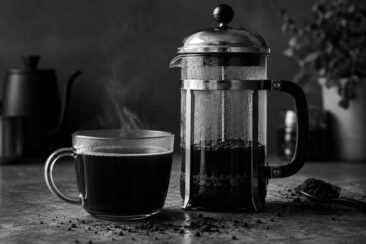
That sharp, puckering tang in your morning cup is your coffee telling you something went wrong during brewing.
Sour French press coffee is one of the most common complaints from home brewers, and the good news is that every cause has a straightforward fix.
The flavor you are tasting comes from organic acids that were pulled out of the coffee grounds before the sweeter, richer compounds had time to dissolve into the water.
This article walks through each reason your French press coffee might taste sour, with specific adjustments you can make before your next brew.
Quick Answer
French press coffee tastes sour when the brewing process does not extract enough flavor from the grounds, a problem called under-extraction. The acids in coffee dissolve first, and if brewing stops too early or conditions are off, those acids dominate the cup without any sweetness to balance them.
Start by grinding slightly finer (medium-coarse, like rough sand), using water at 195°F to 205°F, and steeping for a full 4 minutes. Read on for a complete breakdown of each fix.
Under-Extraction Is the Main Reason French Press Coffee Tastes Sour
Coffee grounds contain hundreds of soluble compounds that dissolve into water in a specific order during brewing.
Organic acids, including citric, malic, and chlorogenic acids, dissolve first within the opening seconds of contact with hot water.
Sugars and caramelized compounds from the roasting process dissolve next, bringing sweetness and body that balance the early acidity.
Plant fibers and heavier bitter compounds come last, adding depth when present in small amounts.
Under-extraction means the brewing process stopped somewhere in that first acidic phase, before the sugars had time to dissolve and round out the flavor.
The result is a cup that hits the back edges of your tongue with a sharp, almost vinegar-like pucker and then fades quickly with a dry, hollow finish.
Every fix in this article targets the same goal: giving water more time, energy, or contact to pull those balancing sweet compounds into your cup.
Your Grind Size Might Be Too Coarse for Proper Extraction
You have probably heard that French press coffee requires a coarse grind, and that advice is correct up to a point.
Grinding too coarse creates large chunks with very little surface area, and water simply cannot reach the flavor compounds trapped deep inside those oversized particles.
Picture trying to dissolve a sugar cube versus a spoonful of granulated sugar in the same glass of water: the cube takes far longer to dissolve, and some of it may never break down at all.
The same thing happens with extra-coarse coffee grounds, where the outer layer gives up its acids and the interior stays locked away.
Quick Tip Aim for a medium-coarse grind that looks and feels like rough sand or coarse sea salt. If your current grind resembles small pebbles or rock salt, you have gone too far.
Adjusting your grinder by one or two notches finer at a time is the safest way to find the right setting without overshooting into bitter territory.
A burr grinder produces far more consistent particle sizes than a blade grinder, which chops beans into a mix of boulders and dust that extracts unevenly.
If you are using a blade grinder and getting sour results no matter what you do, an inconsistent grind could be the hidden cause.
How Water Temperature Affects Sourness in French Press Coffee
Water temperature controls how much energy is available to break apart and dissolve the flavor compounds inside your coffee grounds.
The ideal range for French press brewing sits between 195°F and 205°F (90°C to 96°C), with most roasters and baristas recommending 200°F (93°C) as a reliable starting point.
Below 195°F, water moves sluggishly through the extraction sequence, dissolving the easy-to-reach acids but running out of thermal energy before it can pull out the sugars.
That sluggish extraction is why coffee brewed with lukewarm or merely warm water almost always tastes thin, sharp, and sour.
| Water Temperature | What Happens | Likely Taste |
|---|---|---|
| Below 185°F (85°C) | Very slow extraction, acids only | Sour, thin, weak |
| 185°F to 194°F (85°C to 90°C) | Partial extraction, some sweetness | Slightly sour, flat |
| 195°F to 205°F (90°C to 96°C) | Full extraction, acids plus sugars | Balanced, smooth |
| Above 205°F (96°C) | Rapid extraction, plant fibers dissolve | Bitter, harsh, dry |
You do not need an expensive thermometer to land in the right range.
Boil your water, remove the kettle from the heat source, and wait 30 to 45 seconds before pouring.
That brief pause drops the temperature from 212°F down to roughly 200°F to 205°F, which is the sweet spot for most coffees.
Preheating your French press with a splash of hot water before adding the grounds prevents the cold glass from stealing 10°F to 15°F right at the start of the brew.
Your Brew Time Might Be Too Short to Extract Full Flavor
Time and temperature work together during immersion brewing.
Pulling the plunger down at the 2-minute mark might feel like enough, but at that point the water has barely begun dissolving the sweeter compounds that live deeper inside each coffee particle.
A 4-minute steep is the standard recommendation for French press coffee, and it exists for good reason: it gives water enough contact time to move past the sour acid phase and into the balanced middle range of extraction.
If your coffee still tastes sour after a full 4 minutes, try extending the steep to 5 or even 6 minutes.
Some lighter roasts and coarser grinds genuinely need that extra time to release their full flavor potential.
Common Mistake Plunging the moment you see the grounds start to settle, or pressing down at 2 to 3 minutes, is one of the most frequent causes of sour French press coffee. Set a timer on your phone and wait.
On the other end, steeping for 8 or 10 minutes will likely push the brew into bitter, over-extracted territory, so treat 6 minutes as your upper boundary and adjust from there.
The Coffee-to-Water Ratio Can Throw Off the Whole Cup
Using too little coffee for the amount of water in your press creates a diluted brew where the acids spread thin and dominate every sip.
A 1:15 ratio, meaning 1 gram of coffee for every 15 grams (or milliliters) of water, is the most common starting point recommended by specialty coffee roasters.
For a standard 8-cup (34-ounce) French press, that works out to roughly 50 to 56 grams of coffee and 800 to 850 grams of water.
| French Press Size | Coffee (grams) | Water (grams) | Approximate Tablespoons |
|---|---|---|---|
| 3-cup / 12 oz | 17 to 19 g | 290 g | 3 to 4 tbsp |
| 4-cup / 17 oz | 23 to 25 g | 400 g | 5 tbsp |
| 8-cup / 34 oz | 50 to 56 g | 800 to 850 g | 10 to 11 tbsp |
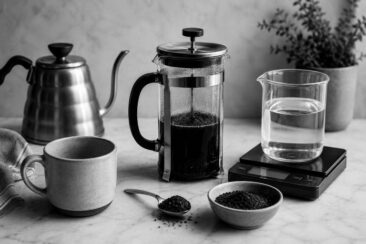
If you have been eyeballing your coffee with a scoop, switching to a simple kitchen scale can eliminate this variable overnight.
Scales cost as little as $10 to $15 and remove the guesswork that comes with heaping versus level scoops, different bean densities, and inconsistent grind volumes.
A ratio that is too strong (1:12 or lower) can push flavors toward bitterness, so stay in the 1:14 to 1:16 range and adjust by a gram or two based on your personal preference.
The difference between 50 grams and 40 grams of coffee in the same 800-gram pour is the difference between a rich, sweet cup and a thin, sour one.
Skipping the Stir Leaves Grounds Unevenly Extracted
Pouring hot water over coffee grounds in a French press does not guarantee that every particle gets equal contact with the water.
Dry pockets of grounds often float on the surface in a thick crust, sitting above the waterline and barely extracting at all.
Those dry pockets contribute nothing but sourness to the finished cup, dragging the overall extraction level down whether or not the submerged grounds are brewing properly.
A gentle stir with a spoon or chopstick for about 10 seconds right after pouring breaks up the crust, sinks the floating grounds, and distributes the water evenly.
Some brewers add a second brief stir at the 1-minute mark to catch any grounds that have floated back to the surface.
The difference between a stirred and unstirred French press can be dramatic: the stirred version will taste noticeably smoother, sweeter, and more complete.
Do and Don’t for stirring your French press:
- Do stir gently for 10 seconds after pouring all the water
- Do use a wooden spoon or chopstick to avoid cracking the glass
- Don’t stir aggressively or repeatedly throughout the entire steep
- Don’t stir with a metal spoon in a glass carafe, as the impact can cause cracks
Light Roast Beans Need Different French Press Adjustments
Light roast coffee retains more of the natural organic acids that are present in raw coffee beans, giving it a brighter, more citrusy flavor profile compared to darker roasts.
That brightness is intentional and desirable when brewed correctly, but a light roast brewed with the same settings you use for a dark roast will almost certainly taste sour.
Light roast beans are physically denser than dark roast beans, meaning water has to work harder to penetrate the cell structure and pull out the full range of flavors.
Grinding one or two notches finer than your usual setting gives the water more surface area to work with.
Raising your water temperature to the upper end of the range, around 203°F to 205°F, gives the water more thermal energy to break into those tighter cells.
Extending your steep time by 30 to 60 seconds beyond the standard 4 minutes can make a real difference with these denser beans.
If you have switched from a medium or dark roast to a light roast and suddenly your French press coffee tastes sour, the roast level is the most likely explanation, and the fix is a few small tweaks rather than a different bean.
Beginner Note Dark roasts taste smoother and less acidic in a French press at standard settings. If you prefer a low-acid cup without adjusting your technique, a medium or medium-dark roast from Central or South America is a good place to start.
Stale Beans Lose the Sweetness That Balances Acidity
Fresh coffee beans contain natural sugars, volatile oils, and aromatic compounds that balance the acidity in every cup.
Those compounds begin breaking down the moment the beans are roasted, and within 3 to 4 weeks, enough sweetness has faded that sourness starts creeping in.
The bloom test tells you a lot about your beans: pour a small amount of hot water over fresh grounds and watch for bubbling and foaming, which signals CO2 trapped inside recently roasted coffee.
Flat grounds that produce no bloom are almost certainly past their peak, and no amount of grind or temperature adjustment will restore the lost sweetness.
Your beans checklist for avoiding stale-sourness:
- Look for a roast date on the bag, not just a “best by” date
- Buy in small batches you can finish within 2 to 3 weeks of roasting
- Store beans in an airtight container in a cool, dark spot away from heat and sunlight
- Grind right before brewing, since pre-ground coffee loses roughly 60% of its aroma within 15 minutes of grinding
Beans that smell like cardboard, paper, or nothing at all have already lost the oils that would have made your cup taste sweet and rounded.
Sour vs Bitter: How to Tell the Difference in Your Cup
Sour and bitter are opposite ends of the extraction spectrum, but they can be surprisingly easy to confuse, especially if you are new to paying close attention to your coffee’s flavor.
Misdiagnosing the problem leads to fixes that make things worse: treating a bitter cup as if it were sour (by grinding finer or steeping longer) will push the coffee even further into harsh, over-extracted territory.
| Characteristic | Sour (Under-Extracted) | Bitter (Over-Extracted) |
|---|---|---|
| Where you taste it | Sides and back edges of the tongue | Back of the tongue and throat |
| Aftertaste | Quick, dry, hollow | Long, lingering, coating |
| Flavor comparison | Unripe fruit, vinegar, lemon rind | Dark chocolate, burnt toast, ash |
| Body/mouthfeel | Thin, watery, sharp | Heavy, astringent, drying |
| Fix direction | Grind finer, brew longer, raise temp | Grind coarser, brew shorter, lower temp |
Take a slow sip and let the coffee sit on your tongue for a moment before swallowing.
If the sharpness hits the sides of your tongue and disappears quickly with a dry, empty feeling, that is sourness from under-extraction.
If the harshness coats the back of your tongue and lingers with a heavy, burnt quality, that is bitterness from over-extraction.
Knowing which direction to adjust saves you from chasing the wrong fix and wasting good coffee in the process.
Water Quality Can Add Sourness You Didn’t Expect
Coffee is roughly 98% water, so the mineral content and pH of your water directly shapes the final flavor of every cup.
Soft water with a pH below 7 sits on the acidic side of the scale and can amplify the sour notes that are already present in under-extracted coffee.
Tap water in some regions contains chlorine, excess minerals, or off-flavors that interfere with a clean extraction and introduce tastes that have nothing to do with the beans.
Filtered water with a neutral pH and moderate mineral content (around 150 parts per million total dissolved solids) will often produce the most balanced, clean-tasting coffee.
If you suspect your water is contributing to sourness, try brewing one cup with bottled spring water and compare it side by side with your usual tap water brew.
A noticeable improvement in the bottled-water cup tells you the issue is at least partially your water source, and a simple carbon filter pitcher can solve the problem for pennies per cup.
A Simple Checklist to Diagnose Sour French Press Coffee
Working through each variable one at a time is the fastest path to a balanced cup.
Change only one thing per brew so you can clearly identify which adjustment made the difference.
Your sour coffee diagnosis checklist:
- Grind size: Does it look and feel like rough sand? If it resembles small pebbles, grind one notch finer.
- Water temperature: Are you waiting 30 to 45 seconds after boiling before pouring? Use a thermometer if you are unsure.
- Brew time: Are you steeping for a full 4 minutes? Try extending to 4:30 or 5:00 if sourness persists.
- Coffee-to-water ratio: Are you using roughly 1 gram of coffee per 15 grams of water? Weigh with a scale.
- Stirring: Did you stir gently for 10 seconds after pouring the water?
- Bean freshness: Do the grounds bloom when you add hot water? No bloom means stale beans.
- Roast level: Are you using a light roast with standard dark-roast settings? Adjust grind, temp, and time upward.
- Water quality: Does your tap water taste clean on its own? Try filtered or bottled water for comparison.
Most sour French press coffee disappears after fixing just one or two of these variables.
The small investment in a kitchen scale, a consistent grind, and water in the right temperature range will transform your morning cup from a sharp, puckering experience into something smooth, sweet, and worth savoring.