A thick, syrupy shot of espresso and a slow, full-bodied pour from a French press could not taste more different from each other, yet they start with the same humble coffee bean.
The brewing method you choose shapes everything from the aroma drifting off the cup to the price tag sitting on your counter.
This french press vs espresso comparison breaks down each method across flavor, caffeine content, grind size, equipment cost, health considerations, and daily convenience so you can pick the brewer that matches the way you actually drink coffee.
Quick Answer
French press coffee uses immersion brewing with coarse grounds steeped for about 4 minutes, producing a heavy, oil-rich cup that averages 80 to 100 mg of caffeine per 8-ounce serving.
Espresso forces pressurized water through fine grounds in roughly 25 to 30 seconds, creating a concentrated 1-ounce shot with about 63 mg of caffeine and a signature layer of crema.
A French press costs $20 to $80, and an entry-level espresso machine starts around $150 to $300, so your budget may settle the debate before your taste buds do.
How French Press and Espresso Brewing Methods Differ
A French press relies on immersion brewing, where coarse grounds sit submerged in hot water for around four minutes before a metal mesh plunger pushes them to the bottom of the carafe.
That slow, gentle contact lets the water pull flavor compounds and coffee oils out of the grounds at a steady, even pace.
You can hear the soft hiss of water meeting fresh grounds, and the aroma of toasted grain fills the kitchen within seconds.
Espresso takes the opposite approach by forcing water heated to 195 to 205 degrees Fahrenheit through a tightly packed puck of fine grounds at roughly 9 bars of pressure.
The entire extraction happens in about 25 to 30 seconds, which is why the finished shot carries such an intense, concentrated punch.
Pressure is the defining variable: without an espresso machine generating that force, you cannot replicate true espresso at home with any manual brewer.
One method rewards patience, and the other rewards precision, so your temperament in the morning may matter as much as your palate.
What Grind Size Does Each Method Need?
Grind size is one of the sharpest dividing lines in the french press vs espresso comparison, and getting it wrong is the fastest way to ruin a cup with either method.
French press coffee needs a coarse grind, roughly the texture of coarse sea salt, so the grounds stay trapped above the mesh filter when you plunge.
Espresso demands the opposite: a fine grind close to powdered sugar that creates enough resistance for pressurized water to extract a full range of flavors in under 30 seconds.
Common Mistake Using pre-ground “drip” coffee in an espresso machine produces a weak, watery shot with almost no crema, and using that same fine grind in a French press creates a bitter, over-extracted mess.
Too-coarse grounds in an espresso portafilter let water rush through without building pressure, so the shot pours pale and tastes thin and sour.
Comparing the Flavor and Body of Each Cup
The flavor gap in any french press vs espresso tasting becomes obvious on the very first sip.
French press coffee delivers a full-bodied, rounded mouthfeel with a velvety weight that coats the tongue, carrying notes that range from earthy and nutty to sweet and chocolatey depending on the bean.
That thick body comes from the metal mesh filter, which lets natural coffee oils pass straight into the cup instead of trapping them the way a paper filter would.
Espresso tastes bolder and more concentrated, with a bright acidity and layered flavors that can include dark chocolate, caramel, toasted hazelnut, or citrus zest.
A well-pulled shot finishes with a thin layer of crema on top: a golden-brown foam created by the emulsion of oils and CO2 under pressure.
| Category | French Press | Espresso |
|---|---|---|
| Body | Heavy, oily, full | Dense, syrupy, creamy |
| Acidity | Lower, smoother | Brighter, more pronounced |
| Flavor range | Earthy, nutty, chocolate | Caramel, citrus, dark chocolate |
| Aftertaste | Long, warm, mellow | Sharp, lingering, bittersweet |
| Crema | None | Yes, golden-brown foam |
French press gives you a more forgiving, approachable cup that works well with most roast levels.
Espresso punishes small mistakes in dose, grind, or timing with sour or bitter flavors, so it rewards practice and consistency.
The two cups sit on opposite ends of the spectrum: one soothes, and the other wakes you up with a slap of concentrated flavor.
How Much Caffeine Do You Get Per Serving?
Caffeine content surprises most people looking at french press vs espresso, since the smaller espresso shot actually contains less total caffeine than a full mug of French press.
An 8-ounce cup of French press coffee averages 80 to 100 mg of caffeine, with some preparations reaching as high as 135 mg depending on the bean type, grind coarseness, and steep time.
A single 1-ounce espresso shot contains about 63 mg of caffeine on average, according to USDA data.
A double shot, which is the default pour at most coffee shops, bumps that number to roughly 120 to 130 mg.
| Drink | Serving Size | Average Caffeine |
|---|---|---|
| French press coffee | 8 oz | 80 to 100 mg |
| Single espresso shot | 1 oz | 63 mg |
| Double espresso shot | 2 oz | 120 to 130 mg |
| Latte (double shot + milk) | 12 oz | 120 to 130 mg |
Ounce for ounce, espresso is about five times more concentrated in caffeine than French press, but you drink far less of it per sitting.
If your goal is the highest caffeine intake from a single cup, a large French press mug will usually deliver more total milligrams than a solo espresso shot.
What Equipment Do You Need and What Does It Cost?
The price gap between these two methods is one of the biggest practical differences in the entire comparison.
A quality French press coffee maker costs between $20 and $80, with popular models from Bodum, Espro, and OXO covering that range.
You do not need paper filters, electricity, or any other accessories beyond a kettle and a grinder to brew French press coffee.
An entry-level semi-automatic espresso machine like the Breville Bambino starts around $300, and mid-range models from Gaggia or Rancilio run $400 to $800.
A capable burr grinder for espresso adds another $150 to $400 to the total cost, since espresso demands a more precise and consistent grind than a French press does.
French press starter kit checklist:
- French press carafe ($20 to $50)
- Burr grinder ($30 to $100)
- Gooseneck or standard kettle ($15 to $40)
- Coarse-ground coffee beans
Espresso starter kit checklist:
- Espresso machine ($150 to $800)
- Espresso-capable burr grinder ($150 to $400)
- Tamper ($10 to $30)
- Scale with timer ($15 to $30)
- Fresh, finely ground coffee beans
Maintenance differs too: a French press needs a quick rinse after every use, and an espresso machine requires regular backflushing, descaling, and gasket replacement over its lifespan.
The total first-year cost for a French press setup hovers around $70 to $150, and a comparable espresso setup can easily reach $500 to $1,200 before you buy a single bag of beans.
A French press makes financial sense for anyone who wants great coffee without a large upfront investment.
Cost alone makes the french press vs espresso decision easy for many first-time home brewers.
Which Roast Works Best for Each Method?
French press brewing coaxes out subtle flavor notes from lighter and medium roasts, letting you taste fruity, floral, or honey-like characteristics that heavier methods can mask, and darker roasts deliver a smokier, more chocolatey cup.
Espresso traditionally favors medium-dark to dark roasts, which develop the caramelized sugars and lower acidity that balance well under high-pressure extraction.
Quick Tip Light-roast single-origin beans can taste sour and thin as espresso if your grind or dose is off, so start with a medium roast if you are new to pulling shots at home.
Lighter roasts work in espresso too, but they require finer grinding and more careful dosing to avoid a sharp, under-extracted tang.
Can a French Press Make Espresso-Style Coffee?
A French press cannot produce true espresso, since it has no mechanism to generate the 9 bars of pressure that define espresso extraction.
The french press vs espresso gap comes down to physics: immersion brewing and pressurized extraction produce completely different results in the cup.
You can brew a stronger concentrate by using a finer grind and a shorter steep time of about 1 to 2 minutes, but the result will taste different from a real espresso shot.
The texture will lack the dense, syrupy crema that gives espresso its signature look and velvety mouthfeel.
Crema forms only when pressurized water emulsifies the coffee oils and CO2 trapped in the grounds, and no plunger can replicate that process.
That said, a strong French press concentrate works surprisingly well as a base for homemade lattes, iced coffee drinks, and other milk-based drinks when you do not own an espresso machine.
Beginner Note If you want to try this method, press the plunger down very slowly and gently to avoid over-extracting the finer grounds and creating a harsh, bitter cup.
Try a 1:6 coffee-to-water ratio with a medium-fine grind and a 2-minute steep for the closest approximation to a concentrated shot.
The flavor profile of a French press concentrate leans more toward a rich, heavy-bodied coffee than the bright, punchy character of an actual espresso.
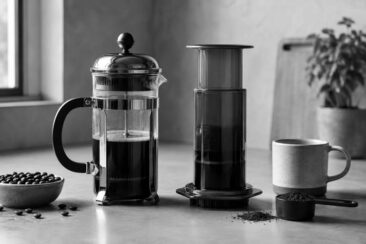
A moka pot or AeroPress will get you closer to espresso strength if the French press concentrate still falls short of what you are after.
The AeroPress, in particular, uses air pressure and a paper filter to produce a cleaner, more concentrated brew than a French press can manage.
Your chosen beans matter more when you push a French press toward espresso territory: a dark roast with low acidity will deliver a smoother, less sour result at shorter steep times.
None of these workarounds replaces the sharp, crema-topped intensity of a proper espresso shot pulled at 9 bars.
How Does Each Method Affect Your Health?
The health side of french press vs espresso centers on two oily compounds called cafestol and kahweol, which belong to a class known as diterpenes.
French press coffee retains far more of these compounds than paper-filtered methods, since the metal mesh filter lets coffee oils pass directly into the cup.
Research published in the American Journal of Epidemiology found that drinking five cups of French press coffee daily could raise LDL cholesterol by 6 to 8 percent over four weeks.
One cardiologist noted that the concentration of cafestol in French press coffee is about 300 times greater than in paper-filtered drip coffee.
Espresso contains cafestol too, but the small serving size, just 1 to 2 ounces per shot, means you consume far less of it per sitting than you would from a large French press mug.
Quick Tip Placing a standard paper coffee filter inside or over your French press before plunging can trap most of the cafestol and reduce cholesterol-related risk, according to cardiologists.
Switching to a darker roast may lower diterpene concentration slightly, since roasting appears to break down some cafestol.
At 1 to 2 cups per day, French press coffee falls well within safe consumption levels for most healthy adults.
The FDA recommends limiting total caffeine intake to 400 mg per day, which translates to roughly 4 cups of French press coffee or about 6 single espresso shots.
Antioxidant content remains high in either method, so the overall health picture for moderate coffee consumption stays positive regardless of your brewer.
If cholesterol is a concern for you, talk to your doctor about whether your daily brew time method needs adjusting.
Which Drinks Can You Make with Each Brewer?
A French press produces a single style of output: a full cup of brewed coffee that you can serve hot or pour over ice.
You can adjust strength and steep time, but the drink format stays the same: a mug of regular brewed coffee.
Espresso functions as the foundation for dozens of popular drinks, including lattes, cappuccinos, americanos, macchiatos, cortados, and flat whites.
Most espresso machines with a steam wand let you froth milk for cafe-style drinks in your own kitchen.
If you enjoy variety and like experimenting with milk-based drinks at home, an espresso machine opens up a much wider range of options than any French press can.
Which Method Fits Your Morning Routine?
Your daily schedule and brewing personality should weigh as heavily as taste preferences when deciding french press vs espresso for your home setup.
French press brewing takes about 5 to 6 minutes from boiling water to finished cup, with no warmup time needed for the brewer itself.
The process is hands-off after the initial pour: set a timer, walk away, come back, and plunge.
Espresso machines need 1 to 3 minutes of warmup time, and pulling a well-dialed shot requires your full attention for grinding, dosing, tamping, and timing the extraction.
Choose French press if you:
- Want a low-cost, low-maintenance brewer
- Prefer a full-bodied, smooth cup with less acidity
- Brew for more than one person at a time
- Like a forgiving method that does not punish small mistakes
Choose espresso if you:
- Enjoy intense, concentrated coffee with crema
- Want to make lattes, cappuccinos, and other cafe-style drinks at home
- Do not mind a steeper learning curve and higher equipment cost
- Prefer speed over volume, since a shot pulls in under 30 seconds
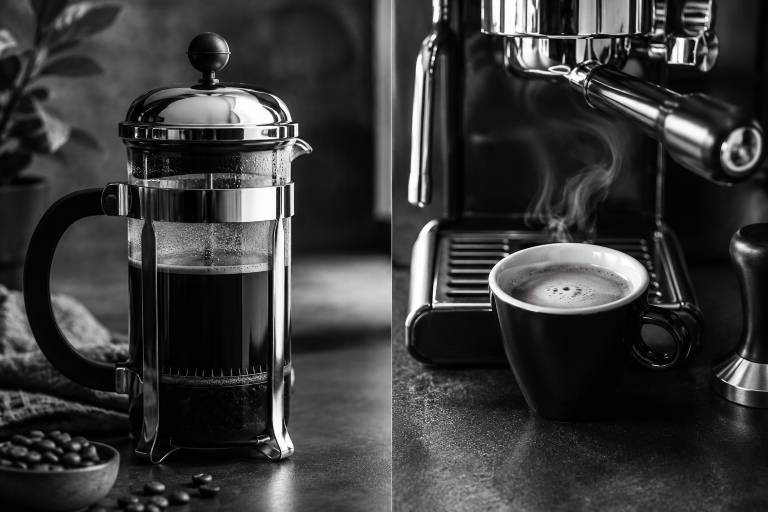
A French press sitting on the counter next to a warm mug and a quiet morning is one of the simplest pleasures in coffee.
An espresso machine humming to life and filling a demitasse with a thick, amber shot is one of the most satisfying.
Cleanup is another consideration: rinsing a French press takes 30 seconds, and cleaning an espresso machine after every session involves wiping the portafilter, purging the group head, and occasionally backflushing.
Noise level differs too, since a French press brews in near silence and an espresso machine grinder can wake up the rest of the house.
Travel is another area where the French press wins: a lightweight plastic or stainless steel model fits in a backpack, and no campsite has a portafilter.
Plenty of coffee lovers own a French press and an espresso machine and reach for whichever one fits the moment.
The best method is the one that gets you excited to brew tomorrow morning.